Key Takeaways
- Scientists who adopt AI publish 3x more papers: Collective AI use has narrowed the scope of research topics by 4.63%. The tools you choose shape whether you produce more work or stronger work.
- No single tool covers the full research workflow: A stack of two to three tools, each matched to a specific bottleneck, outperforms any single platform.
- QED Science is the only tool focused on scientific validation: Use it to dissect manuscripts into individual claims and test each against the literature before submission.
AI can help you publish three times more, but whether it helps you publish better depends on which tools you pick.
Scientific output continues to accelerate, and most researchers already struggle to keep up with the literature in their own field. A study published in Nature in January 2026 analyzed 41.3 million research papers and found that scientists who use AI tools for research produce 3.02 times as many papers and receive 4.84 times as many citations as those who do not.
But that speed comes at a cost. The same study found that collective AI adoption has narrowed the range of scientific topics studied globally by 4.63%.
Publication velocity is up while the breadth of what gets studied is down. Most AI for researchers focuses on finding and summarizing literature, which speeds up discovery but does not address the harder question: whether the claims in a paper actually hold up.
That evaluation is still left to the scientist, and it is the step most likely to be skipped under time pressure.
The most effective researchers are not looking for one tool that does everything. They build small stacks of two to three tools, each matched to a different stage of the workflow, including discovery, synthesis, writing, and validation.
Researchers can use these 11 tools throughout the workflow, from early exploration to pre‑submission checks, with clear guidance on what each tool does and who it suits best.
Why Researchers Are Turning to AI Tools in 2026
Time is one of the biggest constraints for scientists today.
Only 45% of active researchers report having enough time for their own research, and 68% say the pressure to publish has increased. The volume of literature keeps growing, review cycles are long, and the administrative overhead of managing citations, data extraction, and formatting eats into the hours available for actual science.
AI for researchers has evolved rapidly in response. 58% of researchers now use AI tools in their work, up from 37% in 2024.
That growth has moved well beyond simple text generation. The tools researchers rely on in 2026 are built to search indexed literature, extract structured data from papers, map citation networks, and flag weaknesses in manuscripts before submission.
This shift matters because the bottleneck has moved. Finding relevant papers is faster than it has ever been. The harder problem is evaluating what you find and knowing which claims hold up, which arguments have logical gaps, and which results will generalize beyond the conditions they were tested in.
Grammar checkers and writing assistants clean the surface, but they do not catch the inferential leaps that lead to desk rejections at selective journals.
The AI tools for research worth paying attention to in 2026 are the ones that go beyond summarization and address the stages of the workflow where scientists actually lose time, credibility, or funding.
What to Look for in AI Research Tools
Not every tool that calls itself an AI research assistant is built for serious academic work. Before choosing AI tools for academic research, four criteria separate the useful from the generic:
- Source traceability: Every claim the tool generates should link back to a specific paper or dataset. Tools that synthesize answers without clickable, verifiable citations create more risk than they remove.
- Database quality: The tool should draw from recognized, peer‑reviewed indexes like Semantic Scholar, OpenAlex, or PubMed, not unvetted web content or predatory journals.
- Research stage fit: A tool built for literature discovery serves a different purpose than one built for data extraction or manuscript validation. Know which stage of your workflow it covers and where it stops.
- Data privacy and editorial compliance: The tool should have a clear no‑train policy for uploaded manuscripts. The ICMJE's 2026 update on AI in publishing requires full disclosure of AI use in submissions and prohibits listing AI as an author. Any tool you use should make that disclosure straightforward.
Scientific Validation
Most AI research tools focus on finding, summarizing, or organizing papers. This category covers something different by testing whether the claims in a manuscript hold up before it reaches a reviewer.
1. QED Science
QED Science is a Scientific Evaluation Engine built by scientists to critically evaluate research at the claim level. It dissects manuscripts and grant applications into individual claims, both explicit and implicit, and tests each one against the scientific literature, going beyond the sources cited by the author.
The output is structured and specific. QED surfaces where arguments have gaps, where inferences stretch beyond the data, and where the source literature itself contains unsupported or biased findings. Researchers get actionable feedback on what to strengthen before submission.
QED was pre‑trained and fine‑tuned with input from thousands of scientists, including Nobel laureates. Researchers at more than 1,000 institutions use it today. The platform operates under a strict no‑train policy where uploaded manuscripts are not used to train the underlying models, and access is restricted to the author and designated collaborators.
QED fits researchers preparing manuscripts or grant applications who need to identify logical and evidential weaknesses before a reviewer does. It is especially relevant in fields like life science, where the distance between a published claim and a reliable one is often wider than the abstract suggests.
Discovery and Exploration
These tools help researchers find relevant papers, track new publications, and get quick answers grounded in academic databases.
2. Consensus
Consensus is an academic search engine that pulls evidence‑based answers from over 200 million peer‑reviewed papers. It synthesizes findings from multiple relevant studies into a single, cited summary and calculates a "Consensus Meter" showing what percentage of studies support, contradict, or remain neutral on a given question.
Researchers can filter by study design to isolate specific methodologies, like randomized controlled trials. Consensus fits researchers who need a fast, evidence‑level read on whether a specific claim is supported across the literature.
3. Perplexity AI
Perplexity AI is a conversational search assistant that synthesizes web and academic sources into cited, real‑time responses.
Its "Academic" mode restricts results to peer‑reviewed databases, including Semantic Scholar, PubMed, and ArXiv, and researchers can create project‑specific "Spaces" to organize files, transcripts, and notes.
The platform’s "Deep Research" feature runs multi‑step searches for granular landscape data on complex topics. Perplexity fits researchers exploring a new field or scoping the state of evidence through a conversational interface.
4. Semantic Scholar
Semantic Scholar is a free, AI‑driven search engine indexing over 200 million papers across all disciplines. It generates one‑sentence "TLDR" summaries for rapid screening and uses an "Influence Score" to trace research impact over time.
Researchers can set up customizable "Research Feeds" that automatically surface newly published papers in their area. Semantic Scholar fits researchers who want a free, high‑coverage starting point for literature discovery and ongoing field monitoring.
Literature Mapping
These tools visualize how papers connect to each other through citation networks, helping researchers trace the lineage of an idea and spot gaps in their coverage of a field.
5. Litmaps
Litmaps is a visual literature review platform that maps citation networks chronologically. Researchers can build interactive maps sorted by publication date, references, or connectivity to see how a body of work has developed over time.
Its "Monitor" feature scans indexes automatically and sends alerts when new, highly relevant studies appear. Litmaps supports Zotero synchronization for reference library integration. It fits researchers conducting structured literature reviews who want a visual way to track how a field has evolved and where new work is emerging.
6. ResearchRabbit
ResearchRabbit is an interactive citation mapping tool that uncovers connections between papers and authors across open academic indexes. It generates dynamic visual networks representing citation, co‑citation, and reference relationships, and maps author networks to reveal collaboration patterns.
Researchers can import collections from Zotero and receive ongoing alerts as new papers match their saved libraries. ResearchRabbit fits researchers who want to discover related work they would not have found through keyword search alone, particularly when exploring unfamiliar corners of a field.
Synthesis and Extraction
These tools help researchers organize, query, and extract structured data from collections of papers, turning raw literature into usable material for reviews, analyses, and writing.
7. Atlas
Atlas is a collaborative research workspace that organizes uploaded documents and notes into an interactive, visual concept map. It auto‑generates mind maps across large collections of PDFs to surface thematic connections and extracts bibliographic metadata on ingestion to build structured bibliographies.
Its "claim‑source‑justification" engine links claims directly to verified passages in the source files. Atlas fits researchers managing large document libraries who want a visual, interconnected workspace for building arguments from primary sources.
8. Elicit
Elicit is a systematic literature review assistant that automates data extraction and summarizes key findings from empirical papers. It performs semantic search across 138 million papers and extracts structured variables like sample sizes, methodologies, and outcomes into a unified comparison table.
Researchers can upload documents in bulk and export data in academic formats including CSV, RIS, and BibTeX. Elicit fits researchers running systematic reviews or meta‑analyses who need to extract and compare specific variables across a large number of studies.
9. NotebookLM
NotebookLM is a source‑grounded synthesis tool that restricts its reasoning strictly to user‑uploaded documents. It answers prompts and generates guides using only cited passages from the files a researcher provides, which eliminates the hallucination risk that comes with open‑ended AI tools.
Its free plan supports up to 50 sources per notebook (300+ with paid tiers) and can generate briefing documents, study guides, and audio overviews from source material. NotebookLM fits researchers who want a private sandbox for querying their own document collection without any outside data leaking in.
Writing and Citation Context
These tools focus on the final stages of manuscript preparation: refining prose, checking formatting, and understanding how prior work has been received by the scientific community.
10. Paperpal
Paperpal is an academic writing and editing assistant designed to refine manuscript grammar, style, and structure against scholarly conventions. Its grammar engine covers more than 70 suggestion categories specific to academic writing, and its "Preflight" feature screens manuscripts against over 30 standard journal submission checks, including citation formatting.
Paperpal integrates directly into Microsoft Word, Google Docs, and Overleaf, and includes built‑in academic translation, paraphrasing, and a plagiarism checker. It fits researchers in the final drafting stage who want to catch formatting and language issues before submission.
11. Scite
Scite is a citation analysis platform that classifies how subsequent papers treat a given study's claims. It categorizes over 1.4 billion citations as supporting, contrasting, or mentioning, giving researchers a way to see whether a paper's findings have held up over time.
Its browser extension overlays citation context directly onto publisher pages, and its "Scite Assistant" drafts text using contextually classified, evidence‑backed references. Scite fits researchers who want to evaluate the downstream reception of a paper before citing it in their own work.
How to Choose the Right AI Tools for Your Research Workflow
The best AI tools for academic research are the ones that match the specific stage of your workflow where you lose the most time or take the most risk. Most researchers need two to three tools, not one.
Each stage of the research workflow maps to a different category of tool.
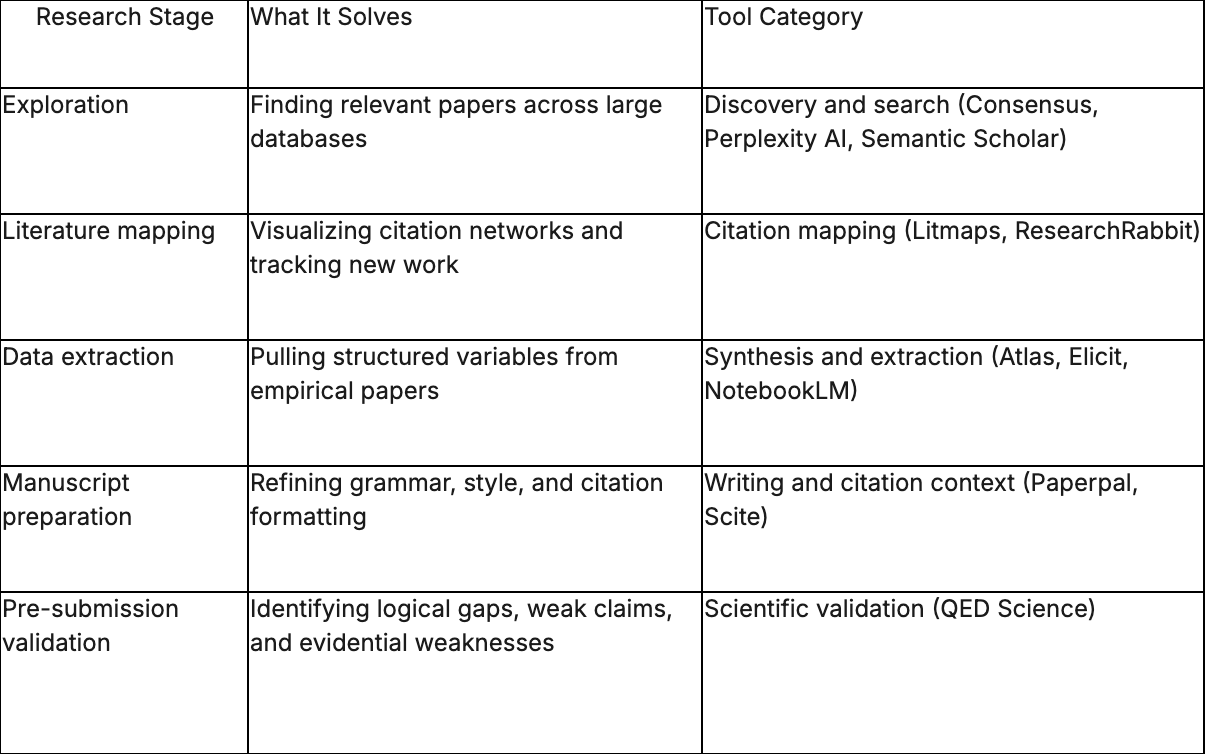
Most stacks cover the first four stages. The fifth, pre‑submission validation, is the one most researchers skip. It’s also where the cost of missing something is highest, as a weak inference or unsupported claim can mean a desk rejection, a failed grant cycle, or months of revision. An author‑centered approach to AI review treats that stage as part of the workflow.
FAQs
What's the difference between AI research tools and AI writing tools?
AI research tools analyze literature databases to map citations, extract data, and synthesize evidence across papers. AI writing tools edit grammar, improve sentence structure, and check formatting. The key distinction is depth: writing tools refine how something is said, while research tools evaluate what the science actually shows.
Are AI tools for research accurate enough to trust?
AI tools are effective for processing large text collections, but they can hallucinate, misattribute sources, or miss context. Researchers should verify all AI‑generated outputs against the original papers. No AI tool replaces a scientist's own judgment. These tools work best as accelerators for critical thinking, with the researcher making the final call.
Can AI replace a literature review?
No. AI accelerates discovery, citation mapping, and data extraction, but synthesizing findings, identifying conceptual gaps, and forming original arguments still require domain expertise and human judgment. AI handles the mechanical parts of a literature review. The interpretive and analytical work remains with the researcher.
Do universities allow AI tools for academic research?
Most universities permit AI tools as supportive aids, with full transparency required. Major publishing bodies like the ICMJE and COPE require authors to disclose AI use in manuscript preparation and prohibit listing AI as an author. Check your institution's specific policy before submission.
Is QED Science free to use?
Yes. QED offers free access starting with a manuscript readiness scan that evaluates the logical structure of your claims. Researchers can sign up with an institutional email and earn additional reviews through community engagement. No credit card is required to get started.