Why Build AI Products With an AI‑Augmented Team
There are two layers to think about. The first is the AI inside your product: an agent, a retrieval system over your documents, a forecasting model. The second is the AI inside the delivery process, where coding assistants draft code and tests while engineers review them.
The first layer decides your budget. In the same release, Gartner estimated that embedding generative AI APIs into a custom app costs about $750,000 to $1 million upfront, while building a custom model from scratch runs about $8 million to $20 million.
Most products sit at the cheaper end, built on existing models plus your data. That's integration and product work, exactly where a team fluent in AI tooling saves time.
The 5 Companies Compared
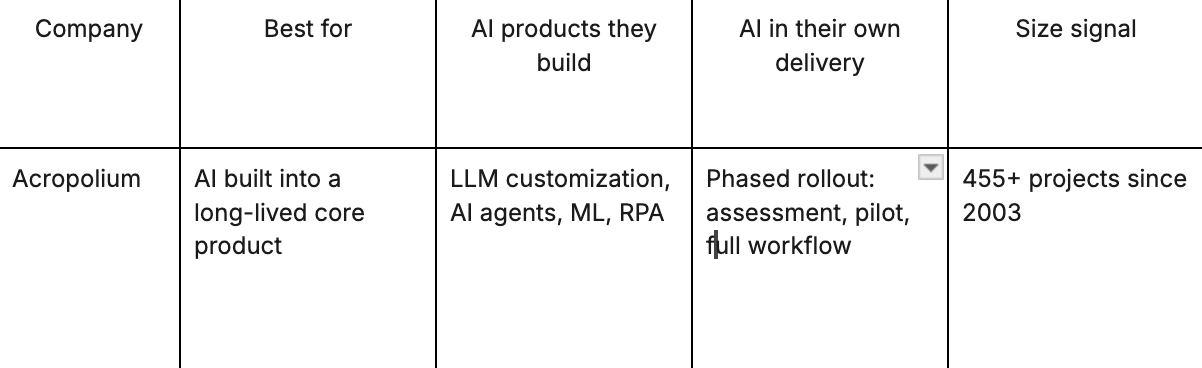
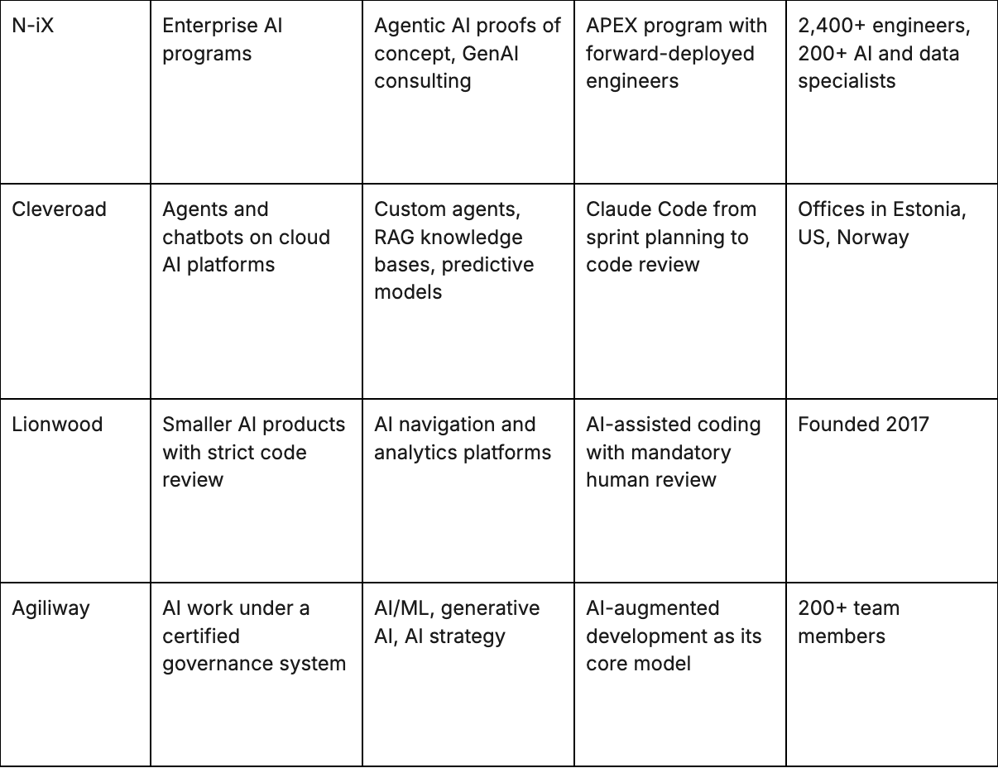
Each row below reflects what the company states on its own website. None of them lists prices, so every engagement starts with a quote.
The Best AI‑Augmented Software Development Companies for Building AI Products
1. Acropolium
Best for: companies adding AI to a product they'll run for years.
Acropolium has built custom software since 2003 and delivered 455+ projects, with five client partnerships running longer than 10 years. Its AI work covers LLM customization, multi‑model integration, AI agents, machine learning and RPA.
Published AI projects include fraud detection software for a digital bank that combines rules with ML scoring, hospital software that forecasts patient demand, and renewable‑energy monitoring with predictive maintenance. For teams unsure where AI pays off, a fixed‑scope AI Readiness Assessment audits workflows and returns a costed roadmap.
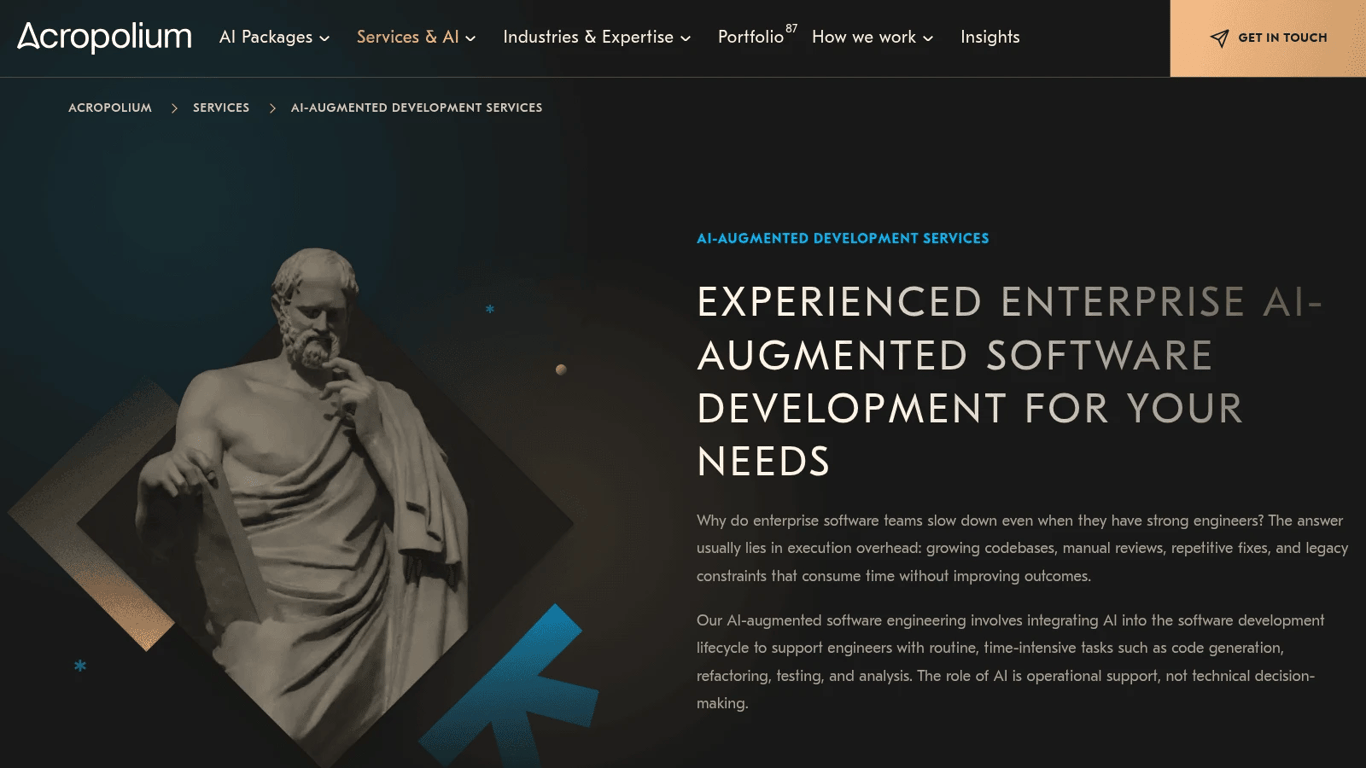
As an ai‑augmented software development company, Acropolium treats AI as support for code generation, refactoring and testing, with engineers accountable for every decision. Rollout starts with baseline metrics and a scoped pilot before AI enters the full workflow.
Pros: AI cases in regulated fields, a defined starting package, long client relationships. Cons: no published prices, and small one‑off builds aren't its focus.
Verdict: the strongest choice here when the AI feature has to live inside a core system for the long term.
2. N‑iX
Best for: large organizations running several AI initiatives at once.
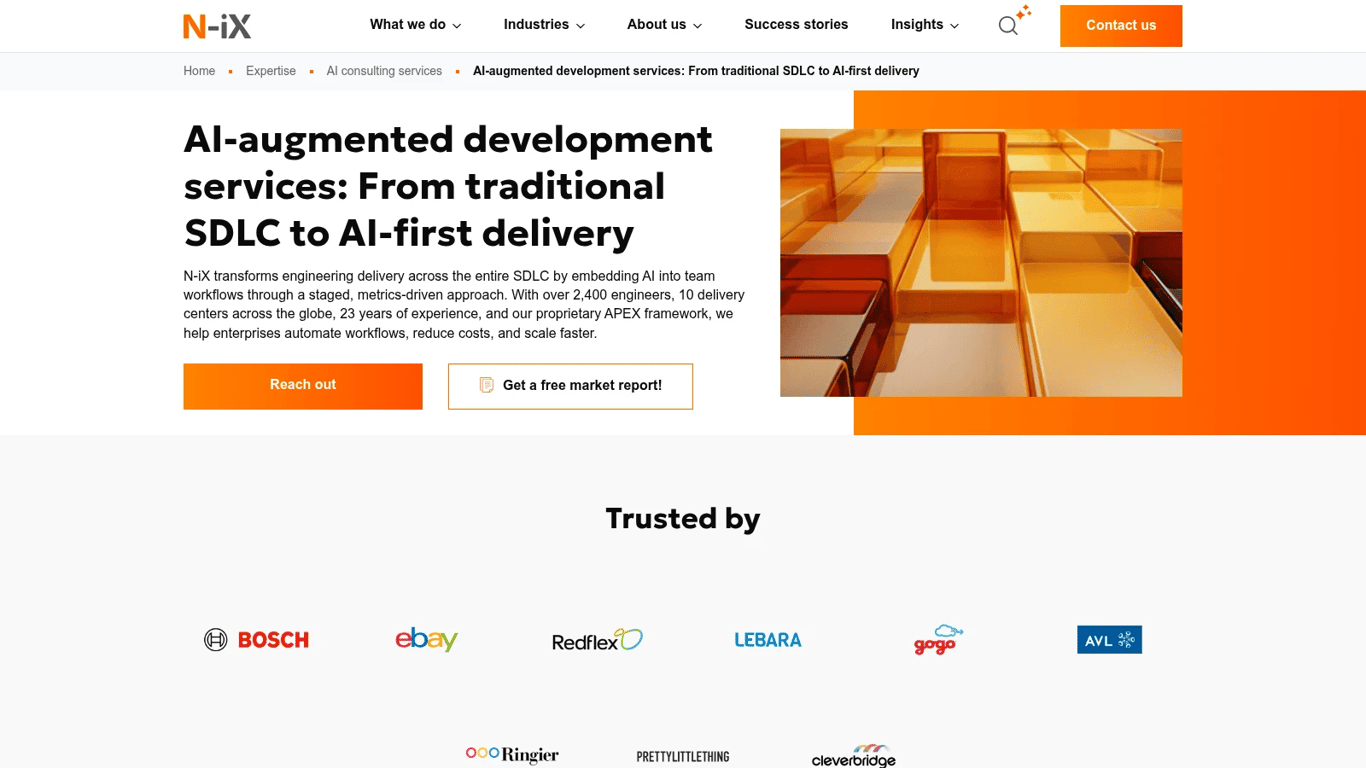
N‑iX employs 2,400+ engineers, including 200+ AI and data professionals. Its AI consulting line includes an agentic AI proof‑of‑concept factory and generative AI strategy work.
For its own delivery, N‑iX uses APEX: a two‑week assessment, a pilot on two or three workflows, then expansion, with engineers embedded in the client's team.
Pros: depth of AI and data staff, a staged adoption model. Cons: built for enterprise scale, which can be heavy for a single product.
Verdict: a fit when AI is a portfolio, not one feature.
3. Cleveroad
Best for: agents and chatbots on major cloud AI platforms.
Cleveroad, working since 2011 from offices in Tallinn, Delaware and Oslo, builds custom AI agents on AWS AgentCore, Vertex AI Agent Builder and OpenAI's Agent Builder. Its AI catalog also covers chatbots, RAG knowledge bases and predictive models.
It's a Claude Partner Network member and runs Claude Code through its process from sprint planning to code review. A software engineer owns every merge.
Pros: wide agent platform coverage, an explicit human‑merge rule. Cons: its AI services page shows no AI‑specific case study.
Verdict: a practical pick for an agent or assistant product.
4. Lionwood
Best for: smaller AI products that need disciplined code review.
Lionwood, founded in 2017 with roots in Ukraine and a US office in Delaware, uses AI for boilerplate, tests and documentation, backed by security scanners such as Snyk, SonarQube and CodeQL. Human review of AI output is mandatory.
Its AI client work includes a public transport navigation platform and an agritech analytics dashboard.
Pros: clear governance rules, named security tooling. Cons: it publishes no headcount, and its AI case list is short.
Verdict: worth shortlisting for a focused first AI product.
5. Agiliway
Best for: teams that need formal AI governance.
Based in Austin, Texas, and staffed from engineering hubs in Kraków, Lviv and Buenos Aires, Agiliway positions itself as an AI‑augmented development and consulting company. It builds AI/ML and generative AI solutions and offers AI strategy consulting.
It holds ISO 42001, the international standard for AI management systems, alongside ISO 27001, and is a member of the AWS, Microsoft and Claude partner networks.
Pros: AI management certification, multi‑vendor partnerships. Cons: no published detail on the tools or review steps behind its AI‑augmented model.
Verdict: a good match when compliance reviewers need paperwork on AI practices.
How We Chose These Companies
Each company had to pass two checks on its own website: it builds AI products for clients, and it describes AI as part of its own engineering process. Directory listings didn't count.
That second check filtered out several firms that build AI features but say nothing about how they use AI to build them.
Questions to Ask Before You Sign
A short call with each shortlisted firm will tell you more than any ranking. Bring the same questions to every one.
- Which AI product of yours is running in production today, and what does it cost to operate?
- Will we build on an existing model with our data, or do we need custom training?
- How do you evaluate model output before and after launch?
- Who approves AI‑generated code before it merges?
- Where will our data be stored and processed during development?
- Can we start with a paid pilot that has a clear go or no‑go metric?
The first and third answers carry the most weight, since running costs and output quality are what sink AI products after the demo.
Picking Your Partner
Match the firm to the shape of your project. For a portfolio of AI initiatives, start with N‑iX. For an agent or chatbot, look at Cleveroad. If the AI has to work inside a core system for years, put Acropolium first, then test any finalist with a paid pilot before committing.