Why Power, Not Capital, Will Decide the Next Phase of AI Data Center Development
The global data center market is entering a new infrastructure cycle, driven by AI, cloud computing, high‑performance computing, and the rapid growth of digital services. According to project‑level data from Blackridge Research’s Global Project Tracker, approximately USD 1.7 trillion in data center capital is currently committed to projects under construction, with a further USD 3.6 trillion tied to announced and planning‑stage projects.
At first glance, these figures suggest that capital is moving aggressively into the sector. Large technology companies, infrastructure funds, private equity investors, energy developers, and real estate platforms are all seeking exposure to AI and data center infrastructure. But capital alone does not determine where projects get built. The harder question is where this investment can be converted into powered, permitted, and operational capacity.
That is why the key issue for the next phase of data center growth is not simply investment. It is execution: whether specific markets have the grid capacity, land readiness, permitting clarity, and construction ecosystem needed to turn announced capital into live infrastructure.
Data Center Growth Is Becoming an Energy Infrastructure Story
Traditional data center site selection has long depended on a familiar mix of factors: land availability, fiber connectivity, latency, tax incentives, customer proximity, and access to skilled construction labor. Those factors still matter, but AI workloads are changing the hierarchy.
Large AI campuses can require power at a scale that looks more like heavy industry than conventional commercial real estate. A single major AI data center campus can require hundreds of megawatts of capacity, depending on the design, customer requirements, cooling approach, and density of GPU deployment.
This is important because grid infrastructure does not scale at the same pace as AI demand. Capital can be raised quickly. Land can be acquired quickly. Customers can sign large capacity commitments quickly. But transmission lines, substations, interconnection approvals, generation capacity, and grid upgrades often move on multi‑year timelines.
As a result, power availability is becoming the practical filter that determines which data center projects move forward and which remain delayed.
A project can have a strong business case, a large site, investor support, and potential tenants. But if it cannot secure power at the right scale and within the right timeline, it may be forced to wait, reduce capacity, phase development more slowly, or redesign its energy strategy.
The Investment Forecasts Are Large, But Not Contradictory
The scale of the current data center pipeline points to a long investment cycle rather than a short‑term construction surge. Large portions of capital are already tied to projects under construction, while an even larger pipeline remains in announced and planning stages. This suggests that the market is moving through multiple layers of development at once: active builds, early‑stage site planning, power negotiations, permitting, and future capacity expansion.
This matters because data centers are not one‑time construction assets. Beyond land, buildings, substations, cooling systems, and backup power infrastructure, operators must also account for repeated investment in servers, GPUs, networking equipment, storage, and other IT systems.
As AI workloads grow, these hardware refresh cycles can become a major part of lifetime project cost, making the data center buildout a multi‑decade capital cycle rather than a single wave of facility construction.
Power Is Now a Core Development Risk
Power is not just a cost item for data centers. It is now a development risk, a competitive advantage, and in many cases, the deciding factor in project viability.
Several power‑related issues are shaping the market:
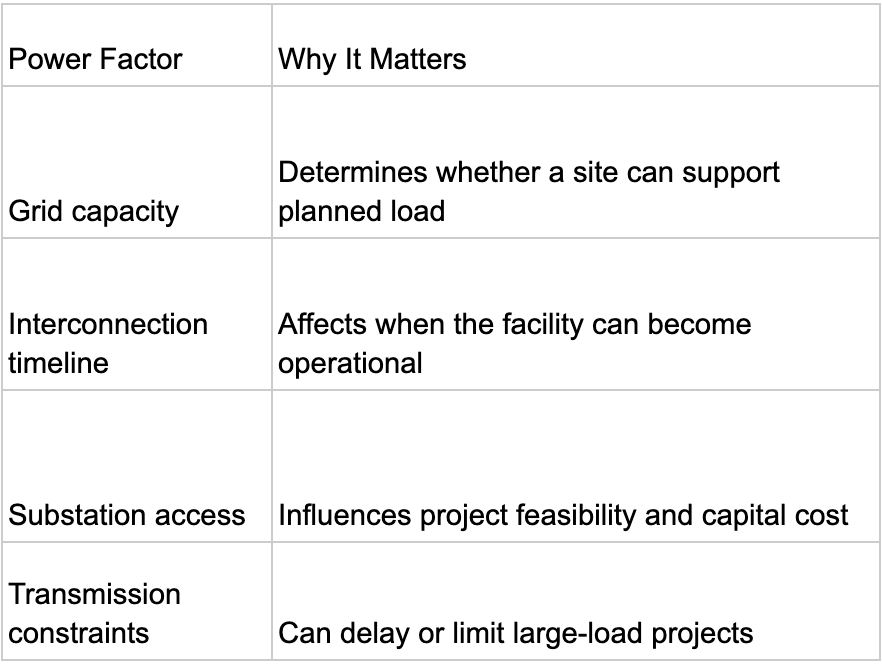
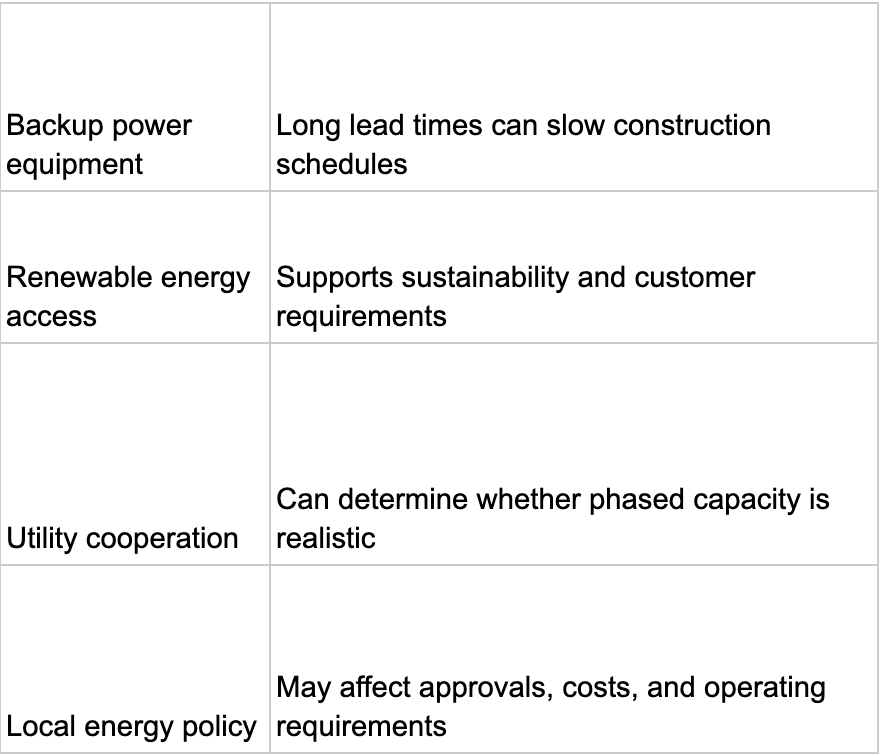
For AI data centers, these factors become even more important because the power density is higher. GPU‑based workloads consume significant energy and produce substantial heat, which also increases cooling requirements. That creates a direct link between compute strategy, energy strategy, and facility design.
In this environment, the most attractive site is not simply the cheapest land parcel or the location nearest to a major cloud hub. It is the location where a developer can secure enough power, connect to the grid, satisfy regulators, manage community concerns, and deliver capacity on schedule.
The Geography of Data Centers Is Changing
The power constraint is already reshaping the data center map.
Established data center hubs remain important because they offer strong connectivity, mature ecosystems, enterprise demand, and access to cloud infrastructure. However, many of these markets are facing constraints such as limited available land, grid congestion, high power demand, low vacancy, and longer development timelines.
This is opening opportunities for secondary and emerging markets. Locations with scalable land, available power, supportive utilities, favorable permitting conditions, and access to transmission infrastructure are becoming more competitive.
For example, markets with faster interconnection processes or more flexible energy procurement options may attract new AI infrastructure projects even if they were not historically considered top‑tier data center hubs. Similarly, regions with access to renewable generation, industrial land, or underutilized grid infrastructure may become more relevant as developers search for power‑ready locations.
Why Project‑Level Data Matters More Than Broad Forecasts
Market forecasts are useful for understanding the direction and scale of the sector. But they do not answer the most practical questions for developers, investors, suppliers, or service providers.
Those questions are more specific:
- Which projects are actually moving forward?
- Which developers are active in which regions?
- What stage is each project in?
- Which projects have disclosed capacity?
- Where are planning applications being filed?
- Which sites have signs of power or utility progress?
- Which regions are seeing delays or opposition?
- Which upcoming projects may create supplier or construction opportunities?
The answers usually appear before public announcements. Early signals often come from planning documents, land records, power agreements, grid interconnection activity, local council meetings, construction permits, and tender activity.
This is where project‑level intelligence becomes more valuable than broad market commentary. The Global Project Tracker (GPT) by Blackridge Research and Consulting tracks infrastructure and industrial projects across major sectors, including data centers, renewable energy, semiconductors, construction, energy, utilities, chemicals, industrial manufacturing, and infrastructure.
The platform supports project intelligence across 150+ countries and 200+ industries, with daily project updates, verified decision‑maker contacts, and coverage used by 500+ client companies. This broader sector coverage helps users monitor where capital, permitting, power availability, construction activity, and supplier opportunities are moving across global infrastructure markets.
For sectors such as data centers, energy, renewables, industrial development, and infrastructure, this type of coverage helps users understand not only where investment is being discussed, but where project activity is actually taking shape.
The U.S. Data Center Market Needs Deeper Visibility
The U.S. data center market is large, active, and increasingly competitive. It includes mature hubs, fast‑growing secondary markets, rural mega‑campus opportunities, and energy‑driven development zones.
However, the U.S. market is also highly fragmented. Project information can be spread across county records, municipal planning portals, utility filings, developer announcements, construction documents, and local news. This makes it difficult to build a clear picture of where upcoming capacity is located and how close each project is to execution.
The US Data Center Projects Tracker powered by Blackridge Research's Global Project Tracker focuses specifically on this challenge. It tracks more than 1,200 upcoming data center projects in the United States, including owner details, site locations, MW capacity, and project timelines.
That matters because data center development is becoming more stage‑sensitive. A project in early planning is very different from one that has secured permits, power agreements, or construction partners. Similarly, a proposed 20 MW facility has a different risk profile from a multi‑phase AI campus with hundreds of megawatts of planned load.
For investors, developers, contractors, equipment suppliers, and consultants, the ability to distinguish between early‑stage concepts and projects with stronger development signals can directly affect business strategy.
AI Is Increasing the Importance of Energy Strategy
AI data centers are not just larger versions of traditional facilities. They have different infrastructure requirements.
High‑density compute environments can require advanced cooling, stronger electrical systems, more resilient backup power, and closer coordination with utilities. This is pushing developers to explore a wider range of power strategies, including:
- Dedicated renewable energy procurement
- Behind‑the‑meter generation
- Battery storage
- Onsite substations
- Microgrid structures
- Long‑term power purchase agreements
- Phased energization plans
- Heat reuse and efficiency improvements
Some projects may also be shaped by regulatory expectations around sustainability, water use, and grid impact. As data centers become larger energy consumers, local governments and communities are paying closer attention to how projects affect power availability, emissions targets, land use, and public infrastructure.
This means the industry’s growth will depend not only on demand from AI companies but also on how well developers integrate with the energy system.
What This Means for the Data Center Ecosystem
The next phase of data center growth will create opportunities across multiple parts of the value chain. Developers will need to identify markets where power and permitting conditions support execution. Investors will need to evaluate whether announced projects have a realistic path to delivery. Utilities will need to plan for large‑load growth while protecting grid reliability.
Equipment suppliers will need visibility into upcoming demand for generators, transformers, switchgear, cooling systems, and electrical infrastructure. Contractors will need to track where construction activity is likely to accelerate.
In this environment, timing is critical. Waiting for public announcements may mean entering the opportunity too late. The most useful signals often appear when a project is still in planning, permitting, land acquisition, or utility coordination.
The companies that can interpret those early signals will be better positioned to understand where the AI infrastructure buildout is actually happening.
Conclusion
The global data center market is entering a long and capital‑intensive growth cycle. AI demand, cloud expansion, and high‑performance computing are driving the need for new capacity across major and emerging markets. But the central constraint is changing. Capital is available. Demand is strong. The challenge is converting that demand into powered, permitted, operational capacity.
That makes power availability one of the most important variables in the future of data center development. Grid access, interconnection timelines, utility readiness, energy procurement, and local infrastructure conditions will increasingly decide where projects are built.