Best AI Digital Signage Software in 2026‑2027
Digital signage is becoming much more than a way to schedule videos and images across screens.
The newest AI digital signage platforms can adapt content to audiences, automate screen management, analyze engagement, recommend products, power virtual try‑ons, and turn displays into interactive customer experiences.
But not every platform uses AI in the same way.
Some focus on managing large networks of screens more efficiently, while others use AI to make the screen itself more intelligent and responsive.
Here are some of the best AI digital signage software platforms to consider in 2026‑2027.
Best AI Digital Signage Software at a Glance
- LOOOK.AI — Best for interactive retail and customer experiences. Key AI capabilities include AI mirrors, product recommendations, virtual try‑on, and interactive AI experiences.
- OptiSigns — Best for audience‑aware digital signage. Key AI capabilities include audience intelligence and responsive content.
- Yodeck — Best for AI‑assisted signage management. Key AI capabilities include natural‑language screen and content management.
- Navori Labs — Best for enterprise content automation. Key AI capabilities include AI‑connected workflows, targeting, and analytics.
- ScreenCloud — Best for enterprise screen networks. Key capabilities include large‑scale screen management and integrations.
1. LOOOK.AI
Best for: AI‑powered retail, interactive displays and experiential digital signage
Most traditional digital signage platforms are built around a simple workflow: upload content, create a playlist and send it to a screen.
LOOOK.AI approaches the screen differently.
The platform turns existing digital displays into interactive Smart Mirror with AI and AR experiences designed for environments such as retail stores, shopping malls, airports, travel retail, events and outdoor advertising.
Instead of simply displaying a campaign, the screen can react to the person in front of it and help them interact with products.
What LOOOK.AI can do
LOOOK.AI supports experiences including:
- AI‑powered product recommendations
- AI clothing virtual try‑on
- Beauty and fashion virtual try‑on
- AI character and visual transformations
- Interactive brand assistants
- AR Mirrors
- AI Mirrors
- Interactive storefronts
- AR and AI billboards
- Branded games and customer experiences
For example, a fashion retailer can turn a display into an AI fitting room, allowing shoppers to visualize multiple outfits without physically changing clothes.
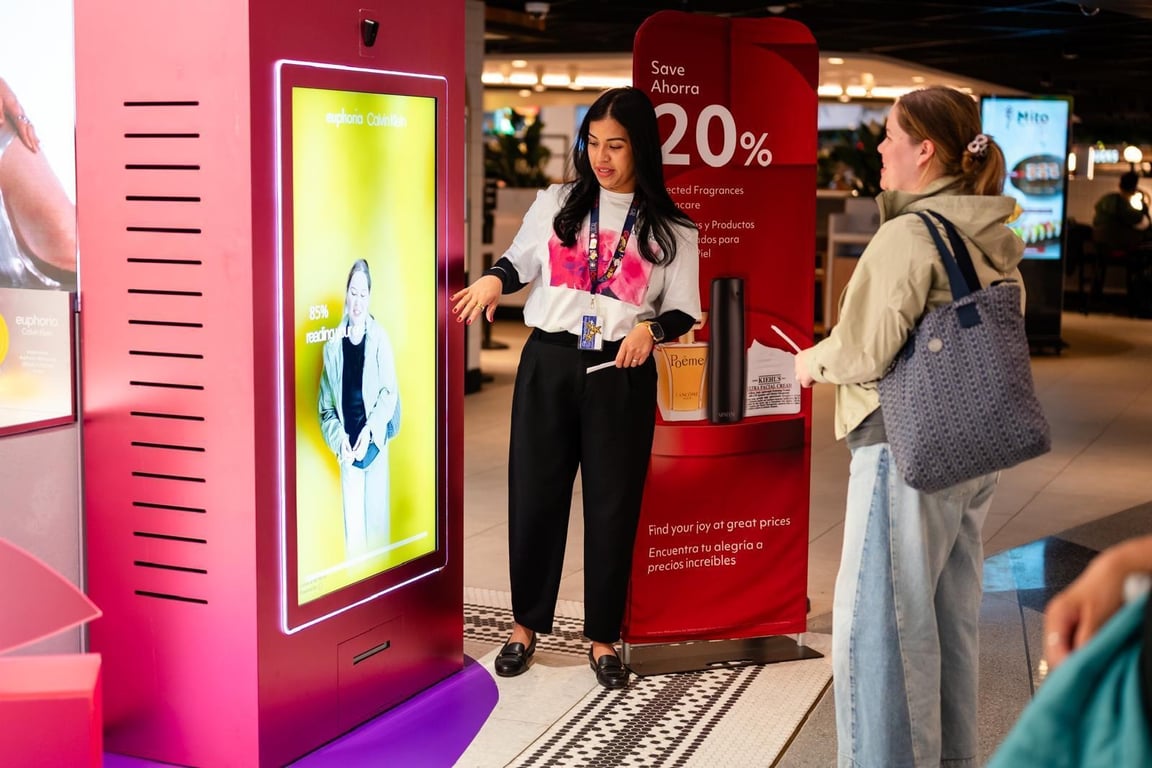
A beauty brand can use the same screen to let customers explore products, virtually try different looks and receive recommendations.
The platform can also combine these interactions with analytics, giving brands more information about how visitors engage with the experience.
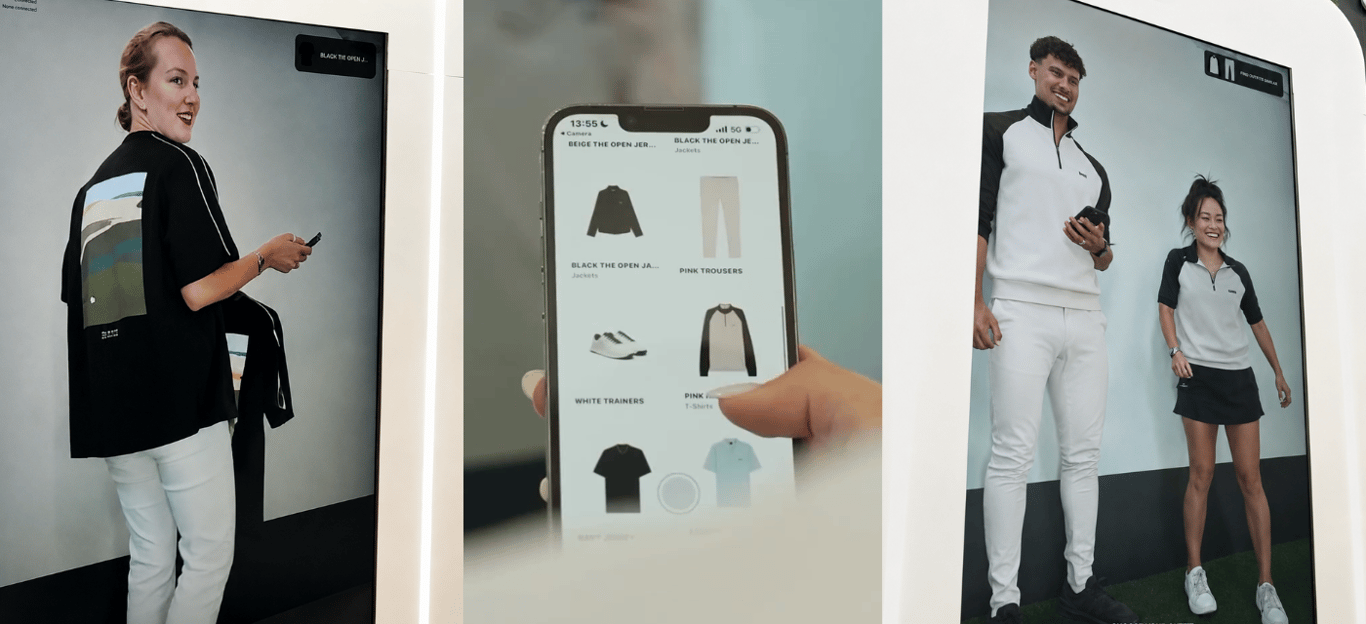
What makes it different
LOOOK.AI is less focused on traditional playlist management and more focused on transforming screens into interactive customer touchpoints.
That makes it particularly relevant for brands looking to connect digital signage with product discovery, engagement, data collection and sales.
LOOOK.AI says its software can work with existing digital screens, helping brands add interactive functionality without necessarily replacing their entire display infrastructure.
Best suited for: fashion, beauty, luxury, FMCG, travel retail, shopping malls, events and experiential marketing.
2. OptiSigns
Best for: Audience‑aware signage and content personalization
OptiSigns is a digital signage platform combining conventional content management with audience intelligence and AI capabilities.
Businesses can manage images, videos, applications, dashboards and other content across screens while using connected sensors and cameras to make signage more responsive.
One of its most interesting capabilities is AI Audience Intelligence.
The platform can use a connected camera to analyze foot traffic and audience characteristics and then trigger different content depending on who is standing near the screen.
For example, retailers could configure different campaigns to appear for different audience segments rather than showing the same promotion continuously.
OptiSigns also offers analytics, scheduling, kiosk functionality, integrations and an online content editor.
Best suited for: retailers and businesses that want a traditional digital signage CMS with an additional layer of audience intelligence.
3. Yodeck
Best for: Managing digital signage with AI assistants
Yodeck takes a different approach to AI digital signage.
Instead of primarily using AI to change what viewers see, the company uses AI to simplify how administrators operate their screen networks.
Its AI Agent lets users connect Yodeck with AI assistants and manage digital signage through natural‑language instructions.
A user can ask the system to perform tasks such as deploying a campaign, updating schedules, identifying unused assets or managing content without manually navigating every section of the signage dashboard.
The AI Agent can work with compatible tools including ChatGPT, Claude, Cursor and VS Code through Model Context Protocol.
Yodeck also provides the traditional components expected from a digital signage platform, including playlists, layouts, scheduling, remote screen management and integrations.
This makes it particularly useful for teams managing a large number of displays where operational efficiency becomes increasingly important.
Best suited for: multi‑location businesses, internal communications and companies managing large digital signage networks.
4. Navori Labs
Best for: Enterprise content automation and data‑driven signage
Navori Labs is an established enterprise digital signage provider focused on content management, automation and analytics.
Its newer platform architecture connects digital signage with data sources, business applications, analytics and AI services.
AI‑powered functionality can help businesses automate content delivery and make screen content more relevant based on available data.
Navori also supports dynamic content feeds, allowing information such as news, weather, social media, traffic information and other live data to update automatically.
For enterprises operating complex signage ecosystems, this combination of automation, integrations and centralized management can reduce the amount of manual work required to keep screens relevant.
Best suited for: enterprises, transportation, large retail networks and organizations with complex signage infrastructure.
5. ScreenCloud
Best for: Enterprise digital signage networks
ScreenCloud is primarily an enterprise digital signage platform rather than an AI‑first customer experience product.
Its strength is operating and managing screen networks reliably at scale.
Companies can centrally manage content, applications and screens while integrating digital signage with existing business systems.
ScreenCloud supports more than 80 applications and integrations and also provides its own ScreenCloud OS hardware environment for organizations that want tighter control over deployment and security.
For businesses exploring AI signage, ScreenCloud can provide the infrastructure layer for distributing data‑driven or externally generated content across a large network.
It is particularly relevant when IT management, reliability, security and centralized control matter more than advanced customer‑facing AI interaction.
Best suited for: enterprise communications, large corporate networks and multi‑location organizations.

What Does “AI Digital Signage” Actually Mean?
The term AI digital signage currently covers several different technologies.
AI‑powered content management
AI can simplify how teams create, schedule and manage campaigns.
Instead of manually configuring every screen, administrators can increasingly use natural‑language instructions or automated workflows.
Audience‑aware content
Computer vision and sensors can help signage understand contextual signals around the screen and trigger more relevant content.
Personalized customer experiences
More advanced platforms can make the screen itself interactive.
AI can help shoppers discover products, receive recommendations or generate personalized experiences.
Virtual try‑on
For fashion, beauty and accessories, AI and AR can allow customers to visualize products directly on themselves through a camera‑enabled display.
AI assistants
Interactive screens can also behave more like digital sales assistants, helping customers navigate products, compare options or receive recommendations.
Analytics and optimization
AI can help brands understand which content or experiences receive attention and use this information to optimize future campaigns.
Traditional Digital Signage vs. AI Digital Signage
Traditional digital signage usually follows a one‑to‑many model.
A company creates content and broadcasts it to an audience.
AI signage introduces the possibility of a more dynamic relationship.
Instead of:
Screen → Content → Viewer
the experience can become:
Viewer → Interaction → AI → Personalized content or action
This shift is especially important in physical retail.
Consumers are already accustomed to personalized recommendations, filters, search tools and interactive interfaces online. AI digital signage brings some of that functionality into stores and other physical environments.
How to Choose AI Digital Signage Software
The right platform depends heavily on what you want the screen to accomplish.
If the goal is primarily to manage hundreds or thousands of screens, look for strong device management, scheduling, integrations, permissions and monitoring.
If the goal is to adapt advertising based on the audience, audience intelligence and camera or sensor integrations become more important.
If the goal is to create interactive retail experiences, prioritize capabilities such as virtual try‑on, product recommendations, AI assistants, interactive games and behavioral analytics.
It is also worth considering your existing hardware.
Platforms such as LOOOK.AI and OptiSigns can add new functionality to existing display setups in certain configurations, while other solutions may rely more heavily on dedicated players or operating systems.
The Future of AI Digital Signage
The biggest change in digital signage may not be generative content.
It may be the transition from broadcasting to interaction.
Screens are beginning to understand context, respond to viewers and connect directly with product discovery and customer journeys.
For enterprise signage networks, AI can reduce operational workload.
For retailers and consumer brands, it can transform a passive display into something closer to a digital sales assistant, fitting room, product discovery tool or branded experience.
That distinction matters when choosing a platform.
A company looking to manage thousands of corporate screens has very different requirements from a beauty retailer trying to create an AI consultation experience inside a flagship store.
The best AI digital signage software is therefore not simply the platform with the longest feature list. It is the one whose AI capabilities match what the screen is actually expected to achieve.