What matters in a Shopify loyalty app
A feature checklist will not separate these tools. Five questions will.
- Does it live inside your store? Loyalty should appear on product pages, in customer accounts, and at checkout, not only in a floating widget.
- Does it reward more than orders? In verticals, where purchase happens every three months, customers need a reason to come back in between.
- Can you prove the revenue impact? A dashboard shows repeat purchase rate, average order value, and lifetime value, but not why they moved. Look for a control group that never sees the program, so you can tell a loyalty lift from a seasonal one.
- Can a merchant run it alone? If every change needs a developer, the program will stop changing.
- Will it survive growth? Check Shopify POS, Shopify Plus, and Klaviyo support before you need them.
The 6 best loyalty apps for Shopify
1. Enable3: best for stores that want proof, not just points
Enable3 ranks first because it answers the question other apps leave open: which mechanic actually changes buying behavior? It is shopify loyalty software built around testing, so you compare options on real customers before you commit budget.
How the testing works. You run one mechanic against another, such as direct discounts against points against VIP tiers, with randomized control groups. Enable3 then calculates the incremental revenue of each variant. You scale the winner and cut the rest, the same way you already treat ads and email.
What you can build. Missions and quests with deadlines, purchase streaks, VIP tiers, and referrals are all set up in a no‑code dashboard. The app can reward a variety of Shopify events, not only orders. A typical first program rewards the second and third purchase with rising benefits, which targets the one‑time buyer problem directly.
Referrals that resist abuse. Rewards are released only after a referred customer completes a qualifying action, such as a purchase. Enable3 says this conditional logic and its fraud detection cut fraudulent claims by 60–80% compared with flat bonuses.
How it fits your stack. The native app connects to a store without developer work, and most programs go live within the same week. Loyalty events sync to Klaviyo automatically, so existing email flows can react to a completed mission or a tier change. Segments by purchase frequency, tier, and region decide who sees which campaign, and you can also target loyalty missions at segments you already built in Klaviyo.
Evidence. The mission‑based approach is documented outside Shopify too. Telecom app eSIM Plus raised repeat purchase rate by 28.8% and average order value by 7.9% after moving from static discount tiers to missions on Enable3.
- Best for: DTC brands in fashion, beauty, food, and lifestyle with a repeat purchase problem, and growth teams that test everything.
- Standout: A/B testing of loyalty mechanics, missions and streaks, fraud‑safe referrals, Klaviyo sync.
- Keep in mind: the Shopify app is in beta, and the team onboards each store personally with a 1:1 setup call.
2. Smile.io: best for a quick, conventional launch
Smile.io is the app most merchants try first, and it earns that position. It holds the Built for Shopify badge and won a 2026 Shopify Build Award.
The program types are familiar: points, referrals, and VIP tiers. What has improved is placement. A Loyalty Hub gives customers one page for points and status, embedded blocks put loyalty on product pages, and checkout extensions show rewards at the moment of purchase. Shopify POS support covers in‑store sales.
Its Performance Benchmarks are useful for new teams, because they show how your program compares with similar stores. A promotions engine adds bonus‑point events and multipliers for sales periods.
Smile shows you how your program performs. It does not tell you whether a different mechanic would perform better.
- Best for: stores that want a proven points program live this week.
- Standout: checkout extensions, Loyalty Hub, industry benchmarks.
- Keep in mind: engagement beyond points and tiers is limited.
3. LoyaltyLion: best for Shopify Plus stores with a retention team
LoyaltyLion is a specialist platform for larger merchants. It draws on behavior data from more than 250 million loyalty members, and its AI layer uses your sales patterns to recommend rewards and campaigns.
Analytics are the main reason to choose it. The dashboard attributes revenue to the program, so loyalty can be defended in a budget meeting. The INKEY List credits loyalty members with 25% of its revenue.
Features include custom tiers, referrals, experiential rewards, goal‑based Challenges, and a headless API for custom builds. It is a Klaviyo Master Elite partner, with more than 100 other integrations.
- Best for: high‑volume stores with someone who owns retention.
- Standout: revenue attribution, AI recommendations, deep Klaviyo data.
- Keep in mind: the depth is wasted without a person to work it.
4. Yotpo Loyalty: best if reviews and loyalty should work together
Yotpo sells loyalty alongside its reviews product, and the pairing is the point. You can award points for a review, then use the same customer profile across both tools.
The loyalty product is flexible on its own terms. Earning rules cover non‑purchase actions, tiers are customizable, and Points Drop sends expiring bonus points to a chosen segment. Apple Wallet passes bring the program into physical retail.
Yotpo adds people to the software. Brands get an implementation specialist, a success manager, and 24/7 support, which matters during a migration.
- Best for: brands already collecting reviews with Yotpo.
- Standout: review‑linked rewards, Points Drop, managed onboarding.
- Keep in mind: much of the value disappears if you only want loyalty.
5. Rivo: best for Shopify Plus brands that want paid memberships
Rivo calls itself a retention platform built for Shopify Plus, and it serves more than 9,000 brands, including Dr. Squatch, HexClad, and Kitsch.
Its range goes past a points program. Rivo offers paid memberships with early access and member pricing, cashback issued as store credit, and personalized customer accounts that work with Shopify's new customer accounts. Loyalty is integrated into Shopify Checkout, so customers can pay with points.
Developers get an open API and toolkit for custom work, and billing is month to month. Kitsch reports that top‑tier VIP customers repurchase 8.7 times more often than other shoppers.
- Best for: established brands building a membership or VIP club.
- Standout: paid memberships, cashback as store credit, customer accounts.
- Keep in mind: designed around Shopify Plus, so smaller stores may not use its full range.
6. BON Loyalty: best for international and B2B stores
BON Loyalty is a widely used app with a 5.0 rating from more than 1,700 reviews. Over 10,000 merchants in 173 countries run it.
The basics are covered: points, referrals with fraud protection, VIP tiers with expiration, and bonus‑point campaigns. Order streak rewards add a light gamified element.
Two things set it apart. It supports more than 250 languages and multiple currencies, which suits stores selling across markets. It also offers a B2B tier program for wholesale customers, a group most loyalty apps ignore. POS rewards and a developer toolkit are available for growing stores.
- Best for: multi‑market stores and merchants with wholesale buyers.
- Standout: language coverage, B2B tiers, round‑the‑clock support.
- Keep in mind: the mechanics stay close to the standard points model.
Quick comparison
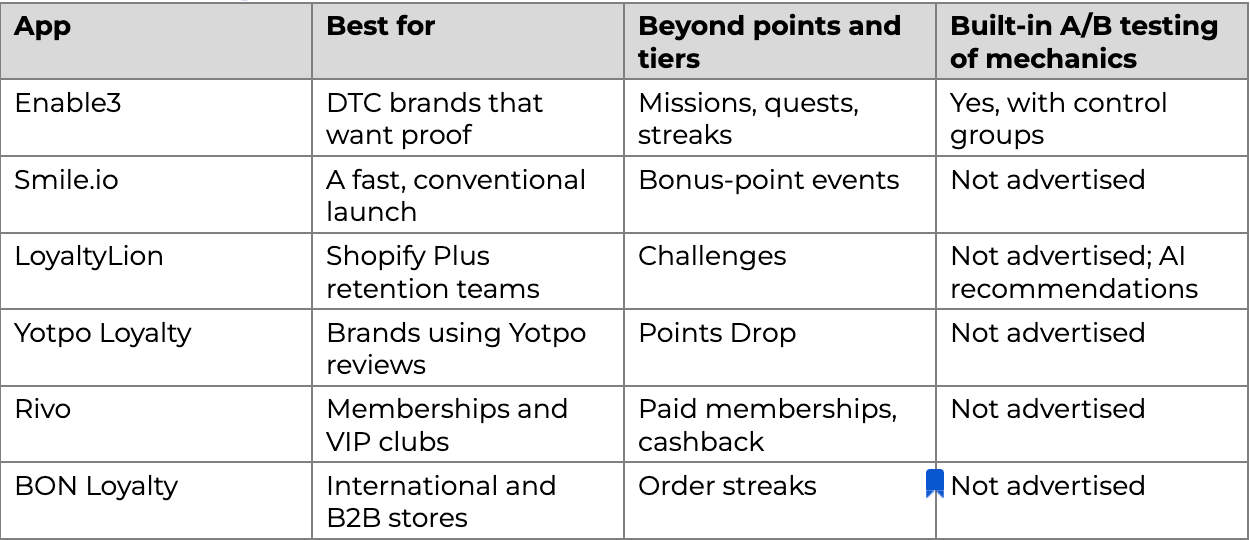
How to choose by store stage
Your stage narrows the list faster than any feature table.
- You are launching your first program. Keep it simple. Smile.io or BON Loyalty will get points and referrals live quickly, and BON is the better pick if you sell in several languages.
- You have a program that is not moving revenue. This is the most common situation, and more points will not fix it. Enable3 lets you test what you run today against alternatives, such as direct discounts against points, before you change the program.
- You are on Shopify Plus with a retention owner. LoyaltyLion suits data‑led teams. Rivo suits brands building a paid membership. Yotpo suits brands that want reviews and loyalty together.
Whatever you pick, set one target metric before launch. Repeat purchase rate is the usual choice. Without it, you cannot tell a working program from a busy one.