Turnkey’s Scoped Sessions announcement separates permission to perform a task from broader account access. That distinction is useful for understanding AI agents, software systems that use tools to carry out tasks. Connecting an agent to a blockchain requires more than an instruction describing the desired result. The wallet also needs a way to determine which requested operations are authorized.
Instructions and Wallet Permissions Do Different Jobs
User control becomes a practical question when software can act through an account. In discussions around crypto and Web3, the distinction between owning an account and delegating access helps explain the role of AI agents. A task tells the agent what to attempt; wallet authorization defines the access available to perform it.
A crypto wallet manages the credentials used to authorize blockchain activity. A digital signature shows that a request was signed with a particular key. Those credentials and the instructions sent to an AI system do different jobs. Asking software to complete a task does not define the wallet operations it may authorize. That definition belongs in the system controlling access. Delegation gives another application a defined role in that authorization process. It does not require treating the application as the account’s owner.
Describing an agent as “connected to a wallet” leaves two questions open. One concerns the software’s ability to prepare blockchain requests. The other concerns permission to have those requests signed or accepted by an account. A connection explains how components communicate; the permission rules explain what that connection enables.
Sessions Define the Actions, Wallets, and Duration
Turnkey describes three dimensions of a scoped session: allowed actions, accessible wallets, and duration. Its published controls permit transaction signing while blocking key export, restrict access to one wallet, and end a session after a set period. Each restriction answers a different question about access.
An action restriction identifies the operation available through that session. A wallet restriction identifies the account it reaches. A duration establishes how long that authorization remains available. Together, these describe the scope of the session without requiring the software using it to hold every permission associated with the user. Signing and exporting a key are separate operations: the first authorizes activity, while the second releases the credential itself. Permission for one need not include the other.
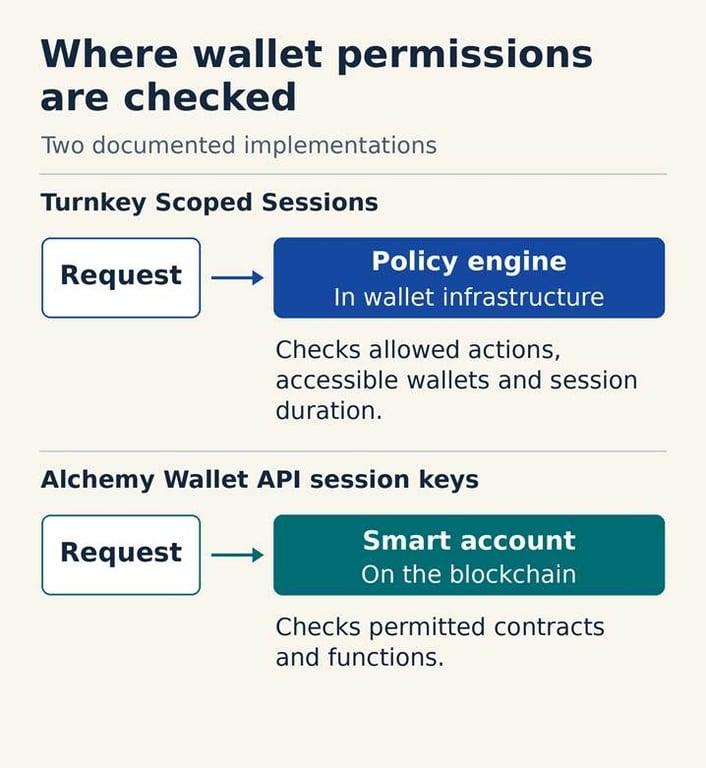
These controls operate inside Turnkey’s policy engine, the component that evaluates requests against its configured rules. They are rules applied by the wallet infrastructure when authorizing an operation. The distinction between the requester and the component checking its request is central to the design: the application supplies a request, while the authorization system applies its configured conditions.
Smart Accounts Check Which Operations Are Allowed
A smart account uses a program running on the blockchain to apply its own authorization rules. Alchemy’s September 2026 guide to agent wallet permissions describes session keys for applications built with its Wallet APIs, the interfaces developers use to connect their software. These credentials let an agent work within permissions approved by the user, without receiving the owner’s key.
Alchemy also describes lists of permitted contracts and functions. A contract is the blockchain program being called; a function is a particular operation within it. Defining both makes the permission more specific than simply allowing software to submit requests. The account’s authorization logic can distinguish the destination from the particular operation being requested there. This is why a permission description needs more detail than the name of an application. The account must have a rule it can evaluate against the actual request.
Alchemy distinguishes this smart‑account approach from its command‑line agent wallet sessions. The latter check access in a backend verification service; Wallet API session‑key permissions are enforced on the blockchain. Turnkey’s policy engine provides another infrastructure‑based implementation. Similar language about sessions can therefore refer to different places where a request is checked.
https://drive.google.com/file/d/1‑M8sw2lrbp33LtOf9Or0‑tUwQ0oR7z26/view?usp=sharing
ALT text: Two request paths show permission checks in different places: Turnkey’s policy engine and an Alchemy smart account on the blockchain.
Image Source: Created with AI
What These Controls Mean for AI Agents
For AI‑assisted Web3 applications, these documented capabilities suggest a division of responsibilities. The agent prepares work through its tools. Its tool connection carries a proposed action to the wallet as a request that can be evaluated. The wallet infrastructure or smart account evaluates the authority behind the request. The blockchain then has its own role in processing submitted activity. These are connected responsibilities, each requiring its own implementation.
Permission also differs from judgment. An authorized request establishes that an operation meets the relevant access conditions. It does not establish that the operation fulfills the user’s intention, or that the software interpreted the task correctly. Explaining the permission boundary therefore makes the agent’s role clearer without making claims about its reasoning. The same distinction applies to conventional automation. Adding an AI model changes how work is selected or prepared, while authorization remains a separate responsibility.
The resulting relationship is specific: the account controller authorizes a set of wallet operations, software works through that grant, and the configured checks apply to its requests. An agent’s ability to plan a task and its authority to use an account remain separate. That distinction gives “autonomous” activity a more precise meaning: work performed within the permissions that were actually granted.