Switching to a cheaper AI model feels like the obvious way to reduce your AI bill. This is the cheap model trap: your discount goes into retries, and you pay more for worse results. Like cheap shoes, the savings rarely last.
The question is what you spend to get the job done properly. That includes the first response and any extra calls needed to correct it.
Yes, the AI model rate matters, but so does your system design, including how often you call AI applications, how much context you force into prompts, and whether you use semantic caching to avoid redundant calls.
Smart development means matching the model and infrastructure to the specific latency budget of the task. Here are a few practical ways developers can reduce the cost of running AI applications without compromising output quality or response speeds.
#1 Measure Cost per Completed Task Rather Than Raw API Rates
Judging an LLM by its raw token rate is one of the most expensive mistakes a team can make. A cheaper model charging $0.40 per run looks great, until its failure rate forces you into repair loops and retries.
Suddenly that budget model costs $1.60 or more per successful task. Meanwhile, a premium model at $1.00 per run that gets it right the first time costs exactly $1.00. To fix this, move your primary metric from cost per API call to cost per completed task. Tools like Helicone or Langfuse can track token usage alongside retry frequency and feature‑specific spend.
Once you calculate spending against successful user outcomes rather than raw network requests, you can pinpoint exactly which pipeline steps are driving value, and which ones are bleeding cash.
#2 Route Simple Prompts to Smaller Models Before Escalating

Source: Solen Feyissa @ Pexels
Using the most expensive AI model for every task is a massive waste of money. Think of it like hiring a top‑tier executive to answer your basic customer service emails. Instead, build a simple sorting system.
Let smaller, faster models handle the routine work, and only call in the heavy‑hitting frontier model when a task gets stuck. In fact, many industry sources and tests have found that only a small fraction of AI steps truly need a premium model. Yet, without a sorting system, those few complex steps end up burning through half your entire budget.
Don’t guess which models to use based on generic internet scores. Pick 50 real examples from your own app’s history to test them out. Seeing how smaller models handle your day‑to‑day traffic gives you the real proof you need to slash costs without sacrificing quality.
#3 Structure Prompts to Maximize Caching and Cap Output Tokens
Prompt caching is easily one of the most powerful cost‑saving tools available today, yet most development teams overlook it.
When you use AI, you are often sending the exact same instructions over and over. Major providers like OpenAI recognize this, offering massive discounts (sometimes up to 95% off) when you reuse identical text.
The idea is, instead of forcing the AI to re‑read your entire background prompt every single time, it recalls its previous work instantly.
The secret to unlocking these savings is order. The AI only remembers text from the very beginning of your message. To make this work, you must stack your permanent text (like guidelines and reference documents) right at the top.
If you want to go a step further, you can try semantic caching. For repetitive tasks like customer service FAQs, the AI can recognize when a new question means the exact same thing as an old one, serving up a saved answer instantly. Just be careful not to make the settings too loose, or the AI might give a saved answer to the wrong question.
#4 Trim the Context, Cap the Output
In the world of AI, less really is more. Every word you send to a model costs money, so you can slash expenses just by being a bit more selective. Instead of sending a massive, unedited chat history with every new question, have your system summarize past messages first. You get the same great results for a fraction of the price.
It’s also smart to keep a tight lid on what the AI sends back. Output words cost significantly more than input words. For example, popular models like Anthropic’s Claude Sonnet 5 charge $3 per million input tokens but $15 per million output tokens. Because advanced “reasoning” tokens are billed at that higher output rate, it pays to set strict output limits.
#5 Match Your Infrastructure to Your Clock
Some AI tasks need an answer right now. Others can sleep on it. Recognizing the difference is one of your biggest cost‑savers.
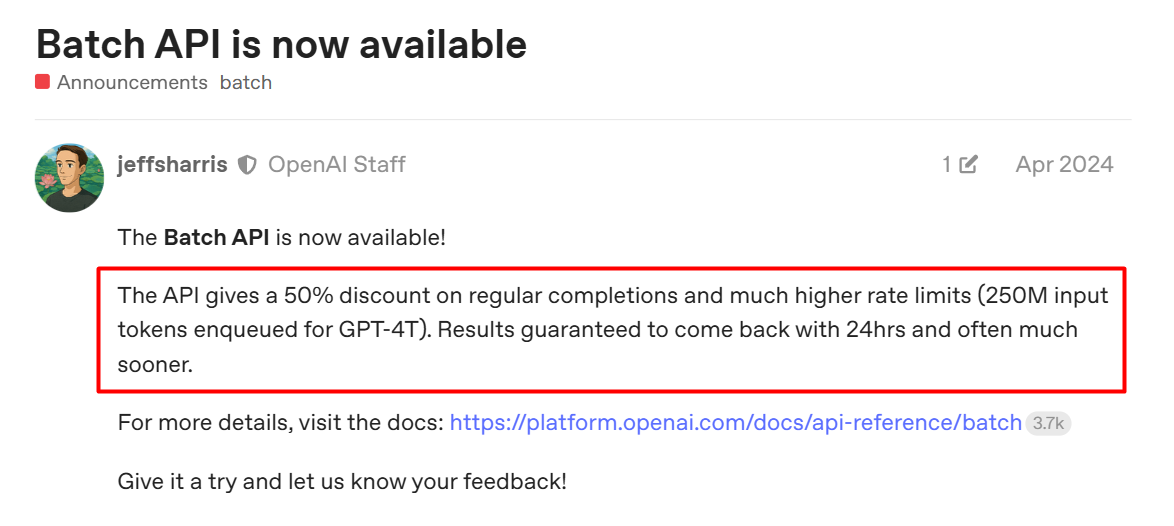
- Batch what can wait. Big AI providers offer a 50% discount if you give them up to 24 hours to deliver results. In reality, these jobs usually finish in under an hour. It’s the perfect system for nightly summaries and offline processing.
Source: OpenAI
- Keep GPUs busy or turn them off. An idle GPU burns money just as fast as a busy one. If you host your own models, use smart tools that pack multiple requests together or scale your capacity down to zero when everyone goes home.
#6 Run the Data Collection Layer Cheaply
Your AI pipeline needs data. Whether it’s RAG retrieval, competitive monitoring, or agent browsing, the collection cost rarely appears in AI cost guides. If you’re pulling web data through proxies, per‑GB pricing grows with every page you fetch.
Flat‑rate VPS servers help keep that cost predictable. You pay for the machine, not the bandwidth. For high‑volume data pipelines, the difference compounds fast. The data layer should be boring and predictable so your AI compute budget stays focused on actual inference.
Key Takeaways
Ultimately, the developers who keep AI costs under control aren’t hunting for cheaper models. They’re restructuring how requests work. Start with the metric that matters. Track cost per successful task, pick one lever, and measure what changes. The bill will tell you if you got it right.