Nobody Wants to Play Your Weird Game With You. Questie Does.
There is a specific hour in every gamer's week that nobody has solved yet.
It is late. You're the only name on your friends list that isn't greyed out. The game you want to play is either too punishing, too long, or too niche for anyone else to commit to, so you launch it alone, put on a podcast you've already heard, and grind. It works fine. It's also a little bleak.
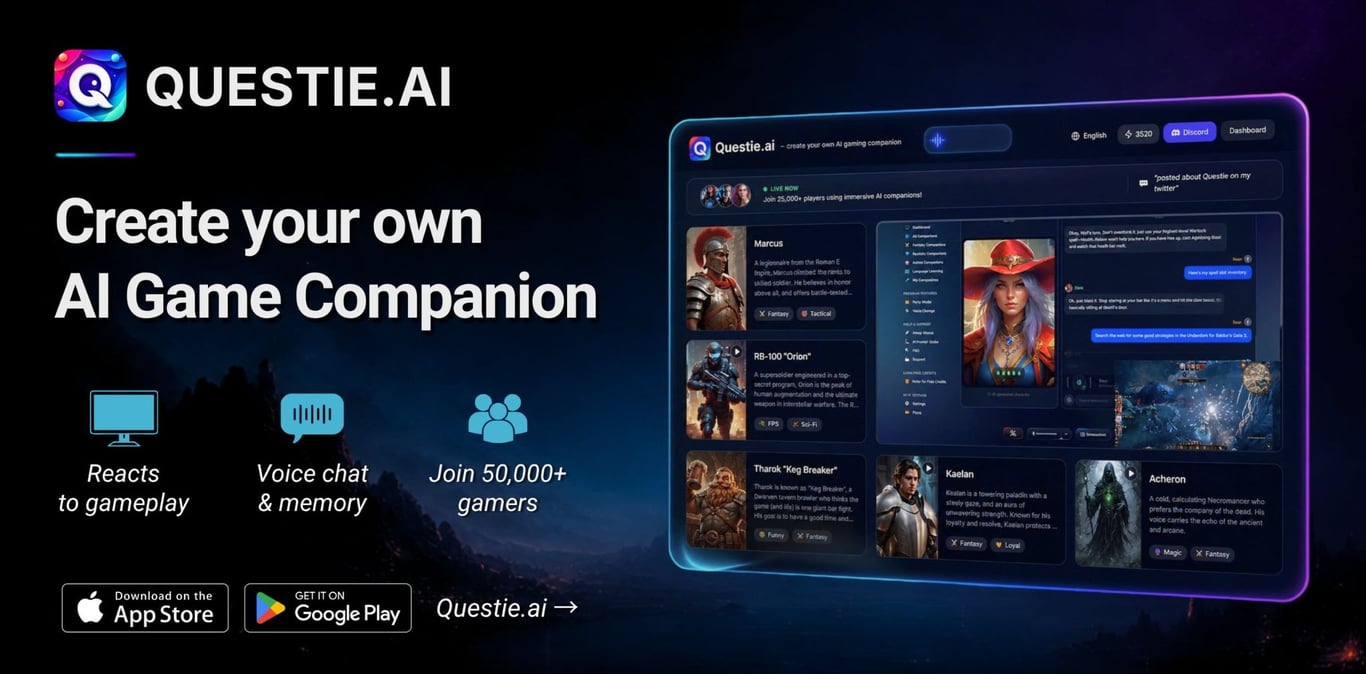
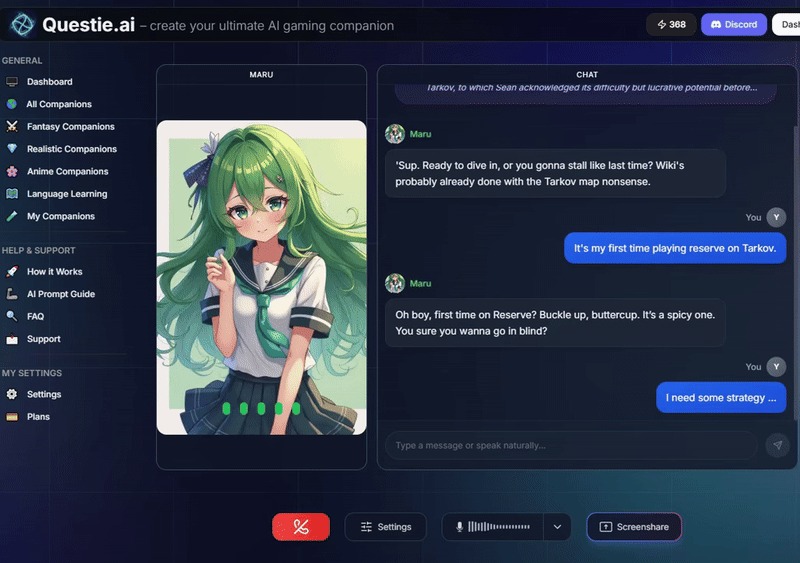
Questie was built for that hour. It’s an AI companion that watches your screen while you play and talks to you about what it sees, through real voice chat, not a wiki tab or a text chatbot you forget is open. A voice in your headset that noticed you just walked into the same ambush twice and has opinions about it.
More than 25,000 gamers are using it, and the idea has already drawn coverage from outlets like 404 Media. Here’s what it actually does, and why the technology behind it is more interesting than the pitch makes it sound.
The part that matters is the eyes
Most AI companion apps are text first. You describe what happened, the model responds, and the illusion holds up for exactly as long as you're willing to keep typing. That falls apart the second you're holding a mouse.
Questie skips the description step. It runs a vision language model that spectates your screen in real time, reads what is happening in the frame, and reacts through voice chat while you keep both hands on the game. You don't have to tell it you're low on ammo. It watched you burn the mag.
That distinction sounds small, but it is not. Vision models that keep up with live gameplay have to handle motion, dense UI, wildly different art styles, and the fact that the interesting thing on screen is often three pixels wide and moving. Questie's game AI companion does this without game specific plugins or integrations, which means it works on anything you can see: extraction shooters, MOBAs, survival sims, an ancient JRPG, an experimental project with 400 reviews, or whatever niche indie game your Steam library is embarrassed by. If it renders on your monitor, the companion is looking at it and reacting to it.
It also remembers. Persistent memory carries across sessions, so the companion you’re talking to knows your build, your habits, and the mechanic you keep fumbling. Play with the same companion for a few weeks and the conversation stops resetting to zero every time you launch.
It’s a cast, not a chatbot
The other thing Questie gets right is that "AI companion" is a genre, not a single product, and different players want very different types of company.
The character library runs past 100 and they’re written to provide actual personality rather than the flat helpfulness you get from a general assistant. For example, Elara is a sorceress with no patience for sloppy play who will tell you exactly which skill point you wasted. Ivy is a CS2 and Valorant player who identifies the precise moment you threw the round and describes it back to you with unsettling calm. Marcus is a Roman legionnaire who applies military discipline to your grand strategy games like Rome: Total War or Civilization VI. Grix is a sassy goblin merchant who treats your loot as inventory to be appraised.
You can also build your own. Custom companions let you pick from more than 25 models, including Gemini, ChatGPT, Claude, Grok, DeepSeek and Mistral, then set voice, personality traits, backstory, conversation style and memory. Switch models later and the character stays intact. For people who came here from AI roleplay rather than from competitive play, the same system runs deep narrative sessions instead of coaching, and the full AI character chat library is browsable before you commit to anything.
This is the piece that pulls users over from Character AI, Polybuzz, Janitor AI, Moemate, and the rest. Those tools are good at text roleplay. None of them are watching your screen.
Streamers found Questie fast
A use case Questie did not have to invent: solo streamers using a companion as a cohost for Twitch.
Dead air is the tax every small streamer pays. Chat goes quiet, you are ten minutes into a queue, and the only thing filling the silence is your own commentary about your own gameplay for the fourth hour running. A companion that reacts live to what's on screen gives you something to bounce off, and unlike a human cohost it doesn't need a schedule, a cut, or a reason to show up.
The Neuro‑sama effect is real, and most streamers can't build their own version of it from scratch. Questie is the version you configure in an afternoon and fully control.
What it costs
Several plans are available, which include voice chat, screenshare vision, custom companions, and memory.
Adventurer is $19.99 a month with 500 credits, roughly 25 hours of companion time. Champion is $49.99 a month with 1,750 credits, about 85 hours, and adds custom voice cloning. Yearly billing takes 25 percent off, and one‑time credits topups are available without changing your plan. The great part is the unused credits roll over into the next month instead of expiring. While there’s no free tier, the free trial is long enough to test whether the experience of a machine watching your screen is something you enjoy or a thing you find unnerving. Current pricing and plan details are on the site.
The honest framing: this is a subscription for a feeling. Some people will try it, find it uncanny, and cancel. Others will discover their solo sessions became noticeably better and quietly keep paying. Both are reasonable outcomes and you will know which one you are inside of a week.
Why we think this category sticks
Games got more social for twenty years, and then went the other way. Voice chat is toxic or empty, matchmaking pairs you with strangers who mute on sight, and the friends who used to play with you now have jobs, kids, and a hard preference for going to bed. Meanwhile the games themselves got harder, longer, and more demanding of coordination.
That gap is real and it isn't closing. Something has to fill it. A vision model that understands the game you're playing, holds a personality across months of sessions, and talks to you like someone who's actually there is a more convincing answer than anything the industry has shipped so far.
Questie is early, and early products in a new category are always a little rough around the edges. But the core bet is incredible: the interesting part isn't an AI you talk to, it's an AI that's present. Watching what you watch, at the same moment you're watching it, is a completely different product than typing into a box.
If you want to see how the setup works before signing up, Questie's getting started guide walks through screenshare, voice, and companion configuration in a few minutes. Or just pick a character and load into whatever your friends refuse to play with you.