Ask a UK business owner what they want from a website in 2026, and they'll rarely mention control over kerning; most people still don't even know what kerning is. They want a working, hosted site by Friday. One.com's Aida lets users build a website with AI through a short chat rather than a template library, inside the wider one.com hosting and domain setup many UK buyers already know. Wix, Durable, 10Web, and Squarespace offer similar conversational builders, but what happens after launch differs more than the marketing suggests.
What These Tools Do Well Now
Describe a business, answer a few prompts about tone and sector, and a conversational builder spins up a hosted site with generated copy, imagery, navigation, and a contact form already wired up. A usable homepage now takes minutes instead of days, which matters most for sole traders and small shops who need a working site without hiring a developer first.
Where The Automation Stops
None of this extends to bespoke design systems or complex integrations; migrations still need a developer, no matter which assistant drew the homepage. For a sense of what else AI tools can automate beyond a single site, OpenTools' tools directory and comparison hub cover categories well beyond website builders.
Five Builders, Compared
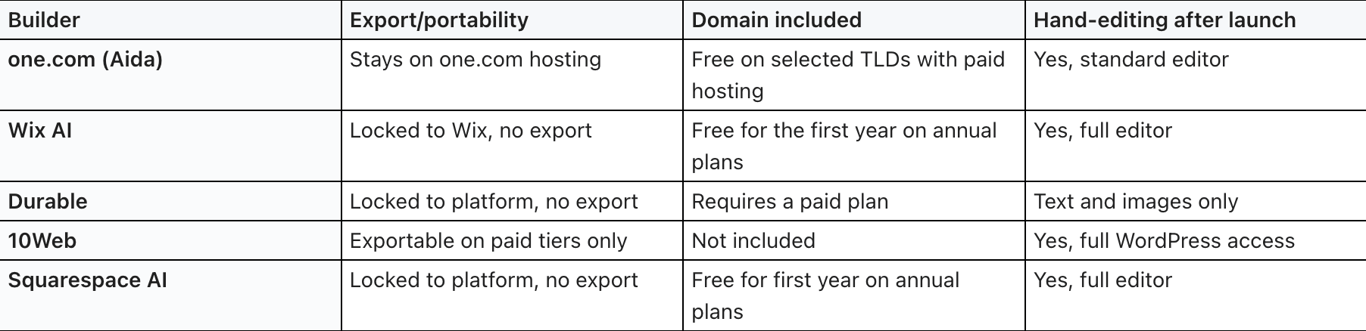
The table below is a snapshot of published plan details checked in early 2026; always confirm current pricing and limits before buying. One.com's Aida stands out for staying fully editable afterward rather than locking a site to a single rigid template path.
What To Check Before Committing
Four questions that anybody should ask before even thinking about which assistant writes the best homepage copy: can the site be exported later, is a domain genuinely included, who owns the generated copy and images, and what happens to the site the moment payment stops? Ownership is still unsettled territory. The UK government's own consultation on AI and copyright left open how authorship applies to AI‑generated content, so a platform's terms of service, not general copyright law, is what actually governs sites today. Accessibility deserves the same scrutiny: the WCAG guidelines are the benchmark most hosting platforms quietly build to, or ignore.
Who Should Use Which
A sole trader who needs a credible booking page by next week is well served by Aida, which gets a hosted, editable site live fast without trapping the owner in a single, export‑proof platform. Anyone expecting to need WordPress plugins down the line will lean toward 10Web instead. An agency delivering a client rebrand with a custom component library should treat any of these as a starting sketch, not a finished build, since generated output resists hand‑editing at every turn.
The pattern across all these tools is the same: speed at launch often trades off control further down the line. For most small UK businesses, that trade is worth making only when the exit door (export, ownership, and portability) stays open, which is exactly where Aida's standard editor and one.com's existing hosting make the difference.