Key takeaways
- Continuous AI penetration testing can help DevSecOps teams reassess risk as software and exposed assets change.
- Look for evidence‑backed findings, clear scope controls, and a practical path from finding to retest.
- Testing cadence varies: some platforms target code changes, while others support scheduled or on‑demand assessments.
- A tool’s fit depends on whether your main concern is application logic, API exposure, cloud context, or human oversight.
- Novee stands out for combining continuous application testing with validated findings and remediation workflows.
DevSecOps teams ship changes faster than periodic penetration tests can keep up with. New routes, APIs, permissions, and integrations can alter an application’s risk profile with every release. Continuous AI penetration testing aims to close that gap by repeatedly probing live software, validating whether a weakness is exploitable, and returning evidence developers can use to fix it.
At a glance
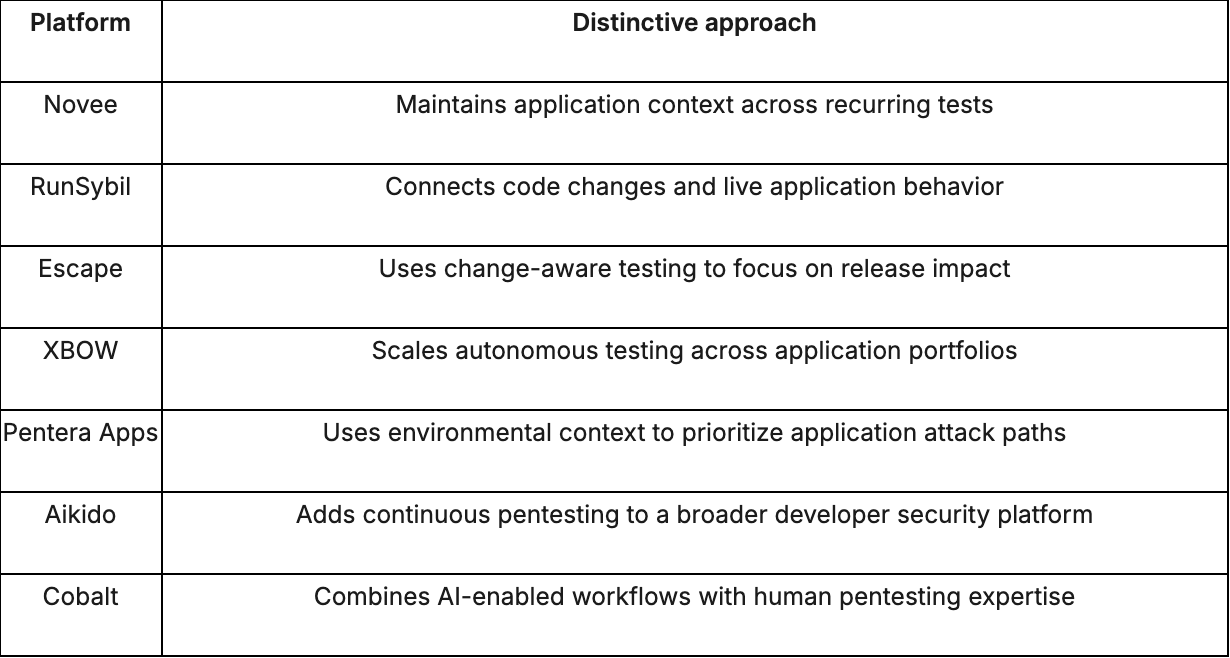
What DevSecOps teams should expect from continuous AI pentesting
Continuous penetration testing is not simply a vulnerability scan that runs more often. The goal is to test software in ways that reveal whether an attacker could exploit a weakness, including through multi‑step workflows and interactions between application components.
Before comparing vendors, separate three functions that are often grouped under “continuous”:
- Change‑triggered testing: Starts after a merge, deployment, or other defined development event.
- Scheduled testing: Runs at an interval, regardless of whether a specific code change occurred.
- Continuous surface monitoring: Tracks changes to exposed assets and uses them to inform security testing.
A useful DevSecOps workflow also needs reliable boundaries. Teams should be able to define targets, test accounts, environments, rate limits, and excluded actions. Results should explain how the issue was reached, what impact was demonstrated, and whether a fix resolved it. The right balance depends on the application and delivery process: a focused test on release changes may fit one team, while a broader recurring assessment may suit another.
7 continuous AI penetration testing solutions for DevSecOps teams
1. Novee: Best Continuous AI Penetration Testing Solution
Novee is designed for teams that want penetration testing to become a recurring part of application security operations. The platform discovers application behavior, tests workflows and attack paths, validates findings, and supports retesting as systems change. Teams can run tests on demand or trigger them through delivery workflows, connecting offensive testing with the rhythm of software releases.
A notable part of the approach is its persistent application intelligence. Novee builds context around workflows, roles, APIs, and business logic, so recurring assessments can use an evolving understanding of the application rather than starting from a blank test each time. The platform reports validated findings with exploit evidence and reproduction steps, giving security engineers a clearer basis for prioritization and developer handoff.
Novee ranks first because the workflow extends beyond finding vulnerabilities. Its focus on repeated testing, evidence, remediation guidance, and verification makes it a strong fit for teams trying to close the loop between application changes and security follow‑through.
- Testing scope: Web applications, APIs, mobile and desktop apps, and AI‑enabled applications.
- Workflow fit: CI/CD triggers and integrations with tools such as GitHub and Jira.
- Evaluation point: Confirm how its testing cadence and target setup map to your environments and release process.
2. RunSybil
RunSybil’s Sybil platform focuses on continuous offensive testing across applications and infrastructure. It can use source‑code changes, live application behavior, or both to inform testing. Teams can configure checks around code activity and choose how often tests run, which gives DevSecOps groups options for connecting penetration testing to development signals without relying only on a calendar‑based schedule.
The platform’s broader scope is relevant when application weaknesses depend on how multiple layers interact. RunSybil describes coverage across code, APIs, cloud, and infrastructure, with testing intended to uncover exploitable paths rather than isolated observations. It also supports recurring testing and workflows for passing findings into engineering tools and applying fixes with coding assistants.
- Testing cadence: Change‑informed and scheduled options.
- Coverage emphasis: Application and infrastructure attack paths.
- Evaluation point: Ask how the platform handles approval gates, test frequency, and findings across multiple repositories.
3. Escape
Escape combines application discovery, API security testing, and AI‑assisted pentesting. Its continuous pentesting approach can be configured around merges, deployments, or a schedule. In change‑focused runs, it uses repository changes to identify relevant application areas to assess, while also replaying open findings to check whether previously identified issues remain present.
This model is designed to help teams focus security testing on what a release changes. Rather than treating each deployment as an entirely new full‑scope engagement, Escape describes its continuous runs as targeted assessments informed by code changes and application routes. Its platform also includes testing for web applications and APIs, and can apply AI red‑teaming techniques when a change touches an AI chatbot, agent, or MCP server.
- Testing cadence: Merge, deployment, or scheduled triggers.
- Coverage emphasis: Web apps, APIs, and selected AI application workflows.
- Evaluation point: Continuous runs use source‑code context and have defined scope and duration limits; check these against your repositories and target setup.
4. XBOW
XBOW uses autonomous AI agents to test web applications and APIs. Its workflow is centered on exploring target functionality, attempting exploitation, and presenting evidence for findings that it validates. Teams can provide scope and testing constraints, then review the resulting attack paths, reproduction steps, and logs of testing activity.
For organizations with many internet‑facing applications, XBOW’s portfolio‑oriented approach may be relevant. Its platform describes parallel testing across multiple targets, which can help security teams extend coverage beyond a small set of high‑priority applications. Teams should still define which applications are authorized for testing and understand how the service behaves when an application is unstable or incomplete.
- Testing scope: Web applications and APIs.
- Workflow emphasis: Autonomous exploration with evidence and activity traces.
- Evaluation point: Check how target scope, testing windows, and existing CI/CD processes will work together.
5. Pentera Apps
Pentera Apps applies agentic testing to web applications and APIs, with an emphasis on using environmental context to guide attack planning. The platform maps routes, endpoints, roles, and workflows, then tests for issues such as business‑logic flaws, access‑control weaknesses, and API exposure. Findings include evidence intended to help teams reproduce problems and prioritize remediation.
The product is part of Pentera’s broader exposure‑validation portfolio. That context may matter to organizations that want to connect application testing with other security signals across cloud, identity, or internal infrastructure. Pentera Apps also describes incremental testing and fix revalidation, which can support teams looking for repeated application assessments rather than isolated point‑in‑time reports.
- Testing emphasis: Web applications, APIs, workflows, and business logic.
- Platform context: Links application findings with broader exposure‑validation data.
- Evaluation point: Verify availability and integration details for your required environments.
6. Aikido
Aikido offers AI pentesting as part of a wider software security platform. Its Continuous Pentesting capability is designed to run targeted follow‑up assessments after an initial full assessment, based on configured deployments or schedules. The platform checks code changes and launches agents for security‑relevant updates, while skipping changes such as documentation‑only commits.
This can appeal to teams that want offensive testing alongside other developer security functions in one environment. Aikido’s broader platform includes capabilities such as code and dependency scanning, secrets detection, and cloud security features. Its continuous pentesting is usage‑based, so engineering teams should consider expected activity and cost controls when estimating frequent runs.
- Testing cadence: Configured deployments or recurring schedules after a baseline assessment.
- Platform emphasis: Developer security functions alongside offensive testing.
- Evaluation point: Review repository prerequisites, usage‑based costs, and test‑environment requirements.
7. Cobalt
Cobalt’s offensive security platform combines technology, AI‑enabled workflows, and a network of human security testers. Its services include human‑led, autonomous, and continuous testing options, with a platform for scoping assessments, tracking findings, and coordinating remediation. This model can suit organizations that want recurring security testing while keeping access to human expertise for selected assessments.
For DevSecOps teams, the key distinction is that “continuous” does not necessarily mean a new autonomous test runs on every code change. Cobalt describes configurable testing frequency and a range of offensive security services; teams should clarify the cadence and human involvement included in the specific engagement they are considering. The platform also supports integrations with tools including Jira and GitHub.
- Testing model: Human‑led, autonomous, and recurring offensive security services.
- Workflow emphasis: Centralized findings, collaboration, and remediation coordination.
- Evaluation point: Ask how often tests run, who validates findings, and what the engagement includes.
How the platforms differ in a DevSecOps workflow
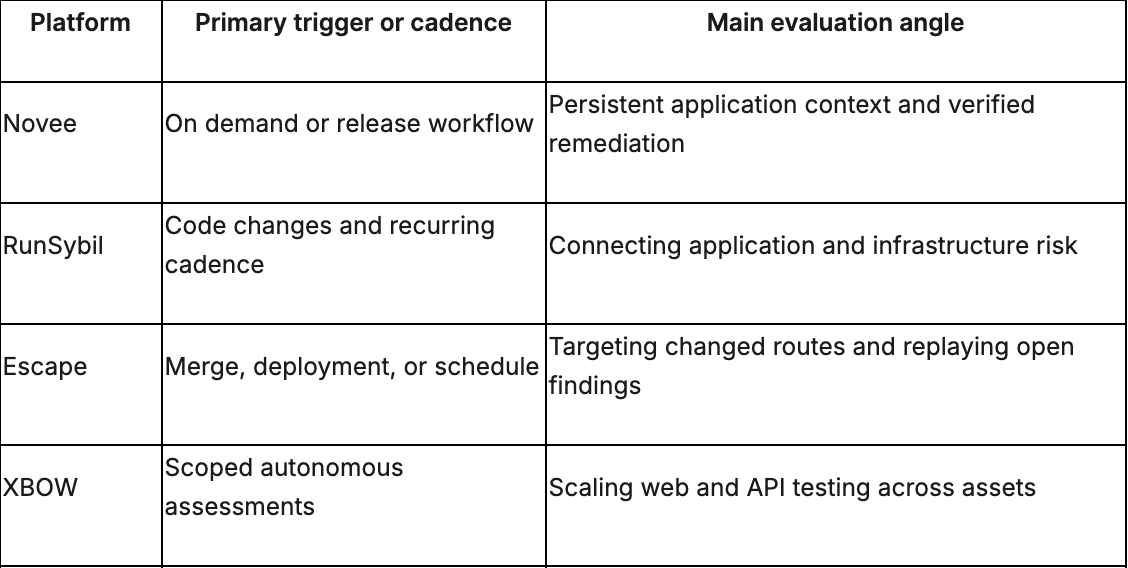
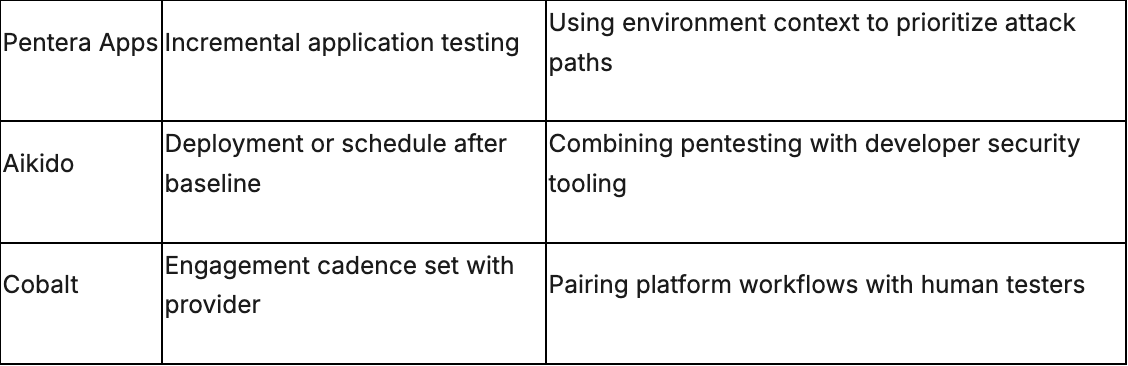
The comparison is about operating model, not a promise that one platform will suit every application. A team with frequent releases may prioritize change‑based triggers and low‑friction developer handoffs. A team with a large portfolio may care more about target onboarding and parallel test capacity. Organizations with strict production constraints should examine scope controls and failure handling before they compare feature lists.
Questions to ask during a pilot
A short pilot can reveal whether a platform fits the team’s workflow better than a vendor demo. Start with one application that has realistic authentication and a representative release cycle.
- What triggers a test? Clarify whether runs start on pull requests, merges, deployments, schedules, or manual requests.
- What evidence accompanies a finding? Ask for reproduction steps, impact explanation, and a way to confirm the issue is fixed.
- How are scope and safety controlled? Review exclusions, test credentials, rate limits, and stop conditions.
- Where do results go? Check whether findings can reach the team’s existing issue tracker and development workflow.
- What is included in “continuous”? Confirm whether recurring tests are full assessments, change‑focused tests, or surface monitoring.
A useful pilot measures more than the number of findings. Track whether results are reproducible, whether developers can act on them without lengthy clarification, and whether retesting confirms that fixes close the original path. Also note any setup work needed to keep credentials, target lists, and repository context current.
FAQs
What is continuous AI penetration testing?
Continuous AI penetration testing uses automated or agentic systems to assess applications repeatedly, rather than relying only on an occasional manual engagement. Depending on the product, tests may run after code changes, deployments, or on a schedule. The goal is to identify and validate exploitable weaknesses as the application evolves, while returning evidence teams can use to investigate and remediate issues.
How is AI pentesting different from DAST?
DAST typically tests a running application using established checks for known vulnerability patterns. AI pentesting may explore application workflows, adapt its testing based on observed behavior, and attempt to chain weaknesses into an attack path. Capabilities differ by vendor, and many teams use both approaches: DAST for repeatable checks and AI pentesting for deeper, context‑dependent testing.
Can continuous pentesting run in a CI/CD pipeline?
Some platforms offer merge or deployment triggers, while others run tests asynchronously or on a schedule. The test may run against a deployed application rather than block the build itself. Before adopting a tool, confirm which event starts a run, how results are delivered, and whether security findings can be used as release gates without slowing routine development.
Does AI penetration testing replace a human pentest?
Not in every case. Automated testing can increase assessment frequency and help teams validate fixes, but human testers may still be valuable for nuanced business context, unusual systems, or engagements that require a named manual assessment. Teams should check compliance expectations and decide where automation supplements existing testing and where human review remains necessary.
What should DevSecOps teams compare before choosing a platform?
Compare testing scope, trigger options, evidence quality, safety controls, integration requirements, and how retesting works. Ask whether the tool needs source code, a prior baseline assessment, or test credentials. Also review pricing against your expected cadence and portfolio size. A pilot on a representative application can show whether findings fit the team’s remediation process.