The stakes are not trivial. In one report on workplace mentoring, 75 percent of executives said mentoring had been critical to their own career development, and research on career advancement found that 49% of individual contributors said a lack of good career advice had hurt their job trajectory. Those are the outcomes an enterprise mentoring program is supposed to move, and the software is either helping or getting in the way.
We compared the platforms that large organizations actually shortlist, on the criteria that decide enterprise deals rather than the ones that decide demos.
What Enterprise Mentorship Software Actually Does
Enterprise mentorship software is a platform that runs the full lifecycle of a mentoring program at organizational scale: enrolling participants, pairing mentors with mentees, supporting the conversations that follow, tracking goals and activity, and reporting on outcomes to leadership. The word "enterprise" is doing real work in that sentence. It generally means the platform can run several programs at the same time, across departments, regions, and languages, from one account, and that it connects to the HR systems the organization already owns.
That is the practical line between enterprise mentorship software and the alternatives. A learning management system is built to deliver and track courses, so it handles content well and relationships poorly. A spreadsheet plus a shared calendar works for a pilot and then stops working somewhere around forty or fifty pairs, usually when the coordinator starts spending more time chasing people than running the program.
Matching models are the rules a platform uses to pair people, and there are four common approaches. Admin matching means a program administrator assigns each pair. Self‑directed matching means participants browse a directory and request the mentor they want. Hybrid matching combines the two, so the software recommends and a person confirms. Competency‑based matching pairs people on demonstrated skills rather than job titles or seniority. Several vendors also market AI matching, which is generally an automated version of the first model, and it is worth asking whether the AI recommends or actually assigns.
How We Compared These Platforms
We limited the list to platforms that are genuinely built for organizational mentoring programs, so mentor marketplaces and individual coaching apps are out. For each one we looked at the matching options, the integrations that enterprise IT will ask about (HRIS, single sign‑on, calendar, video), the reporting a program owner can put in front of an executive, the security posture, and the pricing.
Ratings come from public review directories and are quoted as plain text; we have named the source in each case. Pricing is either the vendor's published figure or the starting price listed on a public software directory, and we have said which is which. Every entry includes at least one limitation, because a comparison without limitations is a brochure.
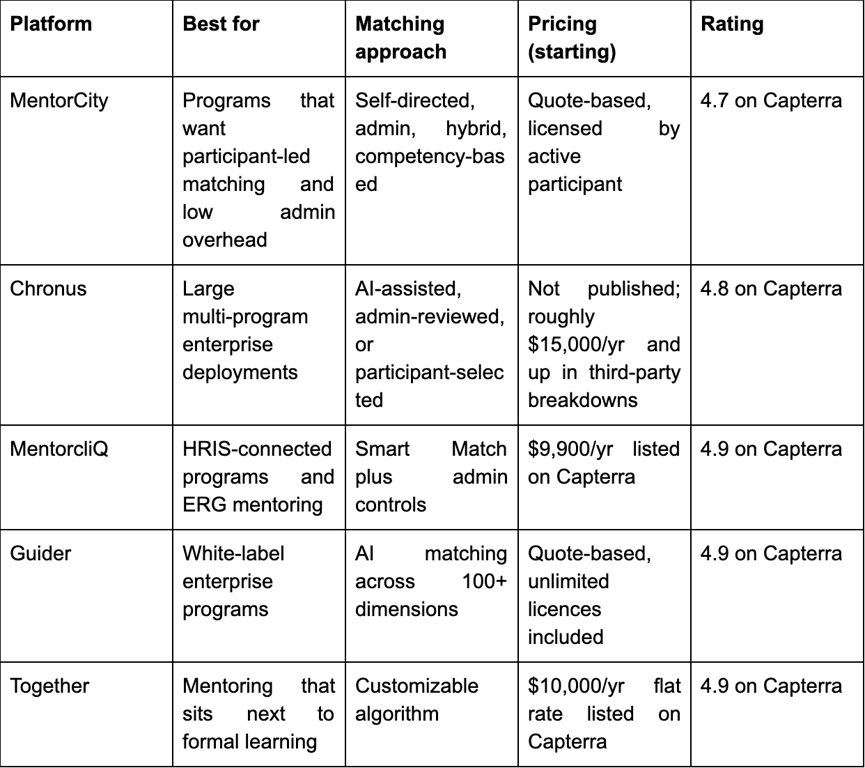
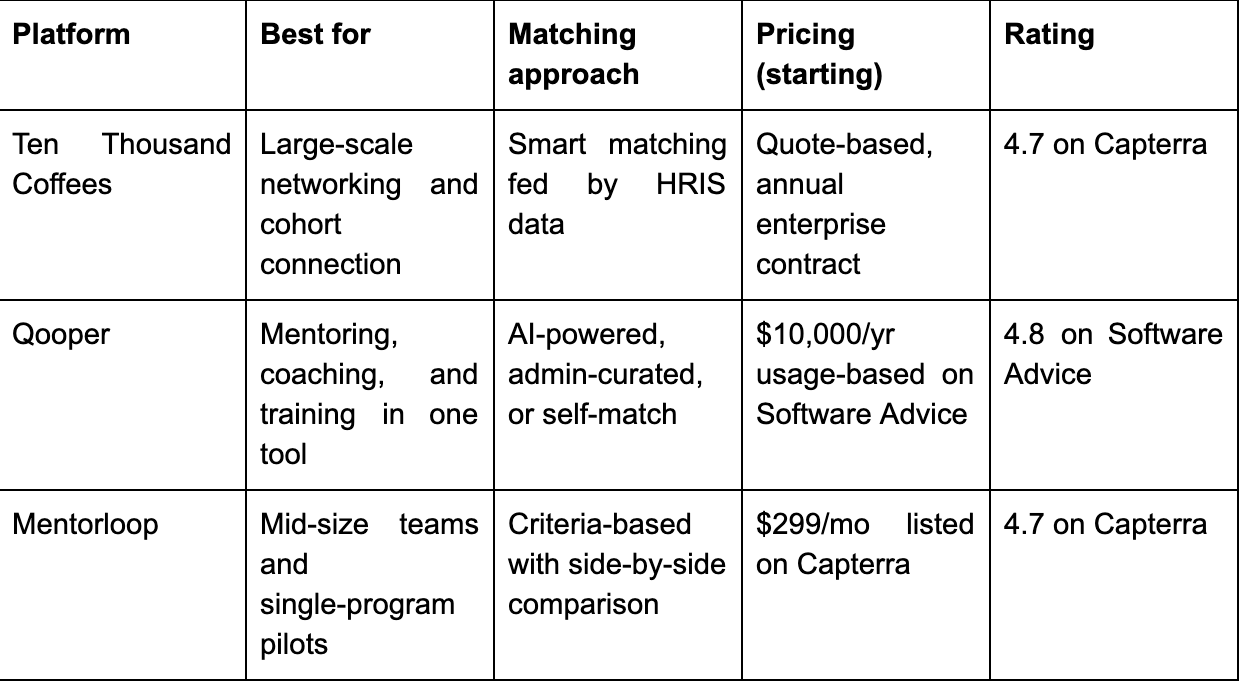
The 8 Best Enterprise Mentorship Platforms Compared
1. MentorCity: Best For Participant‑Led Matching And Low Administrative Overhead
MentorCity is a Canadian platform that has been running organizational mentoring programs since 2011, and its distinguishing choice is that it does not insist on assigning the matches. Selection can sit with participants, with administrators, with both, or with a competency model that pairs people on demonstrated skills instead of job titles, and that setting is configured per program rather than per account. Language is handled the same way, in that Spanish or French is added to an individual program on request rather than being a global account default.
The company is also unusually blunt about its AI. It states that it does not use AI to automatically assign mentors and mentees, and that what is live today is AI note‑taking inside the platform's video sessions plus a conversational AI mentor, named Lexa, that helps participants prepare and reflect between conversations. Administrators switch Lexa on or off per program. On proof, MentorCity reports a 95% satisfaction rate on matches and more than 100 customers, and in the Practice Readiness Education Program run by CPLED, administrative time fell by about 92%, from roughly 700 hours per intake to approximately 50, with no‑shows dropping from 12% to 1.46%.
Key features
- Self‑directed, admin, hybrid, and competency‑based matching, configurable per program
- Integrated video conferencing with AI notetaking, plus messaging and a moderated discussion forum
- Mentoring agreements that trigger automated pulse surveys, discussion topics, and program evaluations
- Group mentoring, Collaboration Spaces, courses and events, goal tracking, and customizable ROI reporting
Rating: 4.7 out of 5 on Capterra, based on 34 reviews.
Pricing: Quote‑based. There are two plans, Standard and Enterprise, and licensing is by active participant, with a free trial available. Capterra lists a starting figure of $350 per user per month, which does not match how the company describes its own licensing, so ask for a written quote rather than working from the directory number.
Where it falls short: The absence of a published price is a real problem in a category where several competitors state a figure, and the review base is smaller than the incumbents, at 34 Capterra reviews against several hundred for Together. If you specifically want the software to assign matches automatically, this is not the platform for that.
Chronus: Best For Large, Multi‑Program Enterprise Deployments
If your organization is going to run career mentoring, reverse mentoring, onboarding, and a high‑potential program at the same time, and each one needs its own rules and its own reporting, Chronus is the platform that most obviously covers that shape. Its matching engine, MatchIQ, combines profile data, behavioural signals, and participant preferences, and administrators can choose whether the system assigns the pair, an administrator reviews it, or the participant picks from a ranked list. The company has also added an AI mentor feature called Rumi. Chronus appears on nearly every roundup in this category, which is both a signal of maturity and a reason to check whether you are paying for scale you do not need.
Key features
- MatchIQ matching with automated, admin‑reviewed, or participant‑selected options
- Support for career, reverse, high‑potential, flash, onboarding, circles, and student or alumni programs
- Guided conversation agendas with in‑platform prompts
- Administrator and executive dashboards covering participation, match health, retention, and internal mobility
Rating: 4.8 out of 5 on Capterra, based on 158 reviews.
Pricing: Not published. Capterra lists it as contact vendor. Independent pricing breakdowns put a starting annual contract in the region of $15,000, with mid‑size deployments commonly quoted between $25,000 and $50,000 per year, and they warn that implementation and integration fees can add materially to the first‑year total.
Where it falls short: This is the most expensive option on the list and the slowest to stand up, with implementation commonly running months rather than weeks. Smaller programs report paying for configuration depth they never use.
MentorcliQ: Best For HRIS‑Connected Programs And ERG Mentoring
MentorcliQ is the platform HR teams tend to name when the mentoring program has to live inside the existing HR stack rather than beside it. Employee profiles are populated from the HRIS, single sign‑on gives people one‑click access, and the program templates cover the formats large employers actually run, including peer mentoring, reverse mentoring, and employee resource group programs. The company publishes customer outcomes with named organizations, including a KeyBank program it reports reduced turnover by 76% and produced $9 million in retention savings. It also ships administrator‑side AI, in the form of an Admin AI and an AI launch assistant, which is aimed at the program owner rather than the participant.
Key features
- Smart Match matching with HRIS‑integrated employee profiles
- Program templates for peer, reverse, virtual, high‑potential, and leadership development mentoring
- Admin AI and an AI launch assistant for program setup and administration
- Reporting that compares program performance against industry benchmarks, plus ATD‑accredited participant training
Rating: 4.9 out of 5 on Capterra, based on 199 reviews.
Pricing: Capterra lists a starting price of $9,900 per year. Custom HRIS and LMS integrations are commonly billed separately, so the quoted figure is rarely the final number.
Where it falls short: The value depends heavily on the HRIS connection being clean, and organizations with older or heavily customized HR systems have reported longer integration timelines. Public documentation of specific security certifications is thinner than we would like for a platform sold on enterprise trust.
4. Guider: Best For White‑Label Enterprise Programs
Guider is the least‑mentioned platform on this list, and we think that is a mistake rather than a verdict. It describes itself as a white‑label mentoring platform designed solely for enterprise, and unlike most of its competitors it includes unlimited user licences and unlimited relationships in every plan, which changes the economics for organizations that want to open a program to everybody rather than a selected cohort. The matching engine works across more than 100 dimensions, from skills to stated goals, and the reporting refreshes close to real time.
Key features
- AI matching across more than 100 participant dimensions
- Full white‑label customization of the participant experience
- Unlimited licences and unlimited mentoring relationships on every plan
- Live reporting with programme‑wide goal attainment and a business intelligence suite
Rating: 4.9 out of 5 on Capterra, based on 62 reviews.
Pricing: No public rate card. Pricing is quoted per organization, and the model is worth noting because unlimited licences are included as standard rather than priced per seat, which suits very large populations.
Where it falls short: The public documentation is light on integrations and security certifications compared with the North American incumbents, so IT review will require more direct questions. The smaller review base also means less independent evidence to work from.
Together: Best For Mentoring That Sits Next To Formal Learning
Together was acquired by Absorb, and that relationship shows up in how the product is positioned, with mentoring sitting alongside an LMS rather than standing on its own. For organizations that already think of mentoring as part of a wider learning programme, that is an advantage. The integration list is the most concrete of any platform we looked at, covering UKG, Workday, SAP SuccessFactors, and Oracle on the HR side, Google Workspace and Outlook for calendars, and Slack and Microsoft Teams for communication. It is also SOC 2 certified, which matters when the security questionnaire arrives.
Key features
- Customizable matching algorithm based on goals, skills, and growth areas
- Health Monitor tooling for spotting relationships that are going quiet
- HRIS integrations with UKG, Workday, SAP SuccessFactors, and Oracle, plus Slack and Microsoft Teams
- Pre‑built program templates, session agendas, discussion content, and ROI reporting
Rating: 4.9 out of 5 on Capterra, based on 387 reviews, which is the largest review base in this comparison.
Pricing: Capterra lists a flat rate starting at $10,000 per year. Third‑party breakdowns put an enterprise tier nearer $20,000 per year and note that integration work is often billed separately.
Where it falls short: Calendar synchronization comes up repeatedly in third‑party reviews as the rough edge, and the entry price is high if you only intend to run one small program. The tie to a wider learning suite is useful for some buyers and irrelevant to others.
Ten Thousand Coffees: Best For Large‑Scale Networking And Cohort Connection
Where most of these platforms start from the mentoring pair, Ten Thousand Coffees starts from the network, and the product reflects that. Its Mentoring Pathways are pre‑built templates that combine mentorship with group learning and networking, and its smart matching pulls live data from the HRIS to pair people on role, skills, goals, and seniority. The company says it is trusted by more than 200 organizations, naming customers including RBC, AIG, and Nike, so the enterprise credentials are real. It is the strongest option here if what you need is many light‑touch connections across a big population rather than a small number of deep, structured pairs.
Key features
- Mentoring Pathways templates combining mentorship, group learning, and networking
- Smart matching fed by real‑time HRIS data
- One‑to‑one, group, and cohort formats, including Office Hours sessions
- Impact Dashboard tying mentoring activity to engagement and other outcomes, plus automated reminders and feedback requests
Rating: 4.7 out of 5 on Capterra, based on 54 reviews.
Pricing: Contact vendor. Capterra does not list a figure. The model is an annual enterprise contract sized to the population, and it is generally aimed at larger employers.
Where it falls short: The networking‑first design is a genuine mismatch for organizations that want long, formal, goal‑tracked mentoring relationships with agreements and structured reporting on each pair. Pricing opacity is also an issue, and the public feature documentation is harder to read than it should be because much of the site requires JavaScript.
7. Qooper: Best For Mentoring, Coaching, And Training In One Tool
Qooper appears on nearly every roundup in this category, and the breadth of the product is the reason. Alongside mentoring it carries built‑in training content, meeting agendas and ice breakers, survey and feedback forms, and a Qooper Insights layer that flags retention risk from what is happening in the programs. Matching is fully customizable and can be run automatically, curated by an administrator, or left to participants, and there is bulk matching for large cohorts. It is SOC 2 Type II certified and GDPR compliant, and there are mobile apps for iOS and Android.
Key features
- AI‑powered matching with automated, admin‑curated, and self‑match options, plus bulk matching
- Built‑in training on mentorship, soft skills, and leadership, with pre‑built program templates
- HRIS integrations covering Workday, BambooHR, SAP SuccessFactors, ADP, and Oracle, plus Slack, Teams, and Zoom
- Real‑time dashboards for engagement, match quality, goal completion, and DEI metrics, plus SOC 2 Type II certification and stated GDPR compliance
Rating: 4.8 out of 5 on Software Advice, based on 170 reviews.
Pricing: Software Advice lists a starting price of $10,000 per year on a usage‑based model. Third‑party breakdowns put enterprise deployments between $15,000 and $25,000 per year, and note that advanced analytics are not included in the base tier.
Where it falls short: The advanced analytics sitting outside the base tier is the complaint we saw most often, and buyers who only want mentoring will be paying for a training and coaching layer they may never turn on.
8. Mentorloop: Best For Mid‑Size Teams And Single‑Program Pilots
Mentorloop is the smallest platform we included, and it is here because plenty of enterprise mentoring starts as one department running one program before anybody signs a corporate contract. The company describes its customers as organizations of roughly 50 to 2,000 or more people, it originated in Australia, and the product is deliberately simple: a recruitment form, filtered matching with side‑by‑side comparisons, a mentoring portal with live chat and file sharing, and a coordinator dashboard with pulse surveys. It is also the only platform in this comparison with a published monthly price you can act on without a sales call.
Key features
- Matching on chosen criteria with side‑by‑side candidate comparison
- Traditional pairs plus peer and team mentoring groups
- Mentoring portal with live chat, file sharing, goal setting, and learning resources
- Coordinator dashboard with real‑time engagement analytics and pulse surveys
Rating: 4.7 out of 5 on Capterra, based on 67 reviews.
Pricing: Capterra lists a starting price of $299 per month. Published tiers work out at roughly $299 per month for up to 100 participants and $499 per month for up to 250, with an enterprise arrangement estimated by third parties at around $10,000 per year, and a limited free tier for building a program.
Where it falls short: Public documentation on HRIS integrations, single sign‑on, and security certifications is thin, which is exactly what enterprise IT will ask about first. For a global program running in several languages across multiple business units, this is the wrong size of tool.
What These Platforms Actually Cost
Pricing in this category is deliberately opaque, and that is the single most frustrating part of the evaluation. Of the eight platforms here, three list a usable starting figure on a public directory (MentorcliQ at $9,900 per year, Together at $10,000 per year, and Mentorloop at $299 per month), one lists a usage‑based annual figure on Software Advice (Qooper at $10,000 per year), and the remaining four quote per organization.
A few patterns are worth knowing before you take the first call.
- The licensing unit varies, and it changes the maths. Some vendors price by active participant, some by total employee headcount, some by flat annual tier, and at least one (Guider) includes unlimited licences as standard. A per‑participant model is cheaper for a selective program and more expensive for an open one.
- The quote is rarely the total. Implementation, custom HRIS or LMS integration, and premium support are frequently billed separately, and independent breakdowns of Chronus pricing suggest these can add a substantial percentage to a first‑year total.
- Implementation time is a cost too. Two to four weeks is common for the mid‑market platforms. Three to six months is common at the top of the enterprise range, and that is a real cost in program owner hours.
- Ask for the renewal terms in writing. Annual uplifts and participant‑count true‑ups are where the second year gets expensive.
How To Choose An Enterprise Mentoring Platform
The eight criteria below are the ones we would score before price enters the conversation, and we would score every shortlisted platform on all of them rather than letting one impressive demo carry the decision.
Start with the matching model, because it is the hardest thing to change later. If you want participants to choose their own mentors, a platform built around administrator assignment will fight you every quarter. If you need every new hire paired to the right person on day one, self‑directed matching will leave gaps. Ask whether the setting is per program or per account, because a single enterprise account frequently needs both.
Then check whether one instance can run many programs. The practical test is not a feature checkbox, it is asking the vendor to run two different programs, with different matching rules, different content, and different reporting, side by side in the same account during the demo.
Integration questions decide enterprise deals more often than feature questions do, so raise HRIS, single sign‑on, and calendar sync early rather than at the security review. On security itself, ask precisely where participant data is stored, whether data residency options exist for your region, and which certifications the vendor will confirm in writing. The information security management standard that most enterprise buyers reference here is ISO/IEC 27001, which the standards body describes as the world's best‑known standard for information security management systems, and a certificate is a document a vendor can produce rather than a claim on a slide.
Accessibility deserves the same treatment, particularly for a program that will be offered to an entire workforce. The published accessibility guidelines set success criteria at three levels, A, AA, and AAA, and Level AA is what procurement teams usually specify. Ask for a conformance report rather than a statement of intent.
Two more things, and then a caution. Reporting has to produce something a program owner can hand to an executive without rebuilding it in a spreadsheet, so ask to see the actual report layouts. Administrative burden is worth quantifying honestly, because the hours a coordinator spends chasing participants are the hidden running cost of every mentoring program.
The caution is about AI. Every vendor in this category now markets AI features, and they are at very different stages. Ask which features are live in production today, which are in beta, and which are on the roadmap, and then score only what you can use this year. Separate participant‑facing AI from administrator‑facing AI, because they solve different problems, and ask specifically whether AI recommends matches or assigns them. If what you are shortlisting is enterprise mentorship software where matching stays under human control and the administrative load stays low, MentorCity is built around exactly that position, with AI supporting the relationship rather than running it.
The Bottom Line
There is no single best platform in this category, and any list that says otherwise is selling something. Chronus and MentorcliQ are the safe institutional choices for large, multi‑program deployments with deep HR integration, and they are priced accordingly. Together and Qooper cover the broadest feature surface, with Together strongest on named integrations and Qooper strongest on breadth beyond mentoring. Guider is the most interesting option for organizations that want to open a program to everyone. Ten Thousand Coffees is the right answer for networking at scale rather than structured pairs. Mentorloop is a sensible place to start a first program. MentorCity is the one to look at when participant choice and low administrative overhead matter more than an automated matching engine.
Score all of them on the eight criteria first, ask for pricing in writing, and make every vendor show you two programs running side by side before you decide.