Most teams now draft with AI. The drafts arrive fast, and they often sound the same: the same openers, the same three‑item lists, the same cheerful sign‑off. Readers notice. A brand that sounded distinct last year can start to sound like every other company in its category.
The fix is not to stop using AI. It is to give the tool your voice in a form it can follow, and to check its output against that voice before anything goes out. This workflow takes an afternoon to set up and a few minutes per piece after that.
Step 1: Collect what your best writing already does
Start with evidence, not adjectives. "Friendly but professional" means nothing to a person or a model. Pull five to ten pieces your team is proud of: a launch email, a help article, a few social posts, a sales page. Then look for patterns:
- How long are the sentences? Do you use contractions?
- Do you address the reader as "you"? Do you say "we"?
- Which words do you use often, and which do you never use?
- How do you open a piece, and how do you close it?
Write down what you find. These patterns are your voice.
Step 2: Turn the patterns into rules
A model follows concrete rules better than descriptions. Rewrite each pattern as an instruction a reviewer could check.
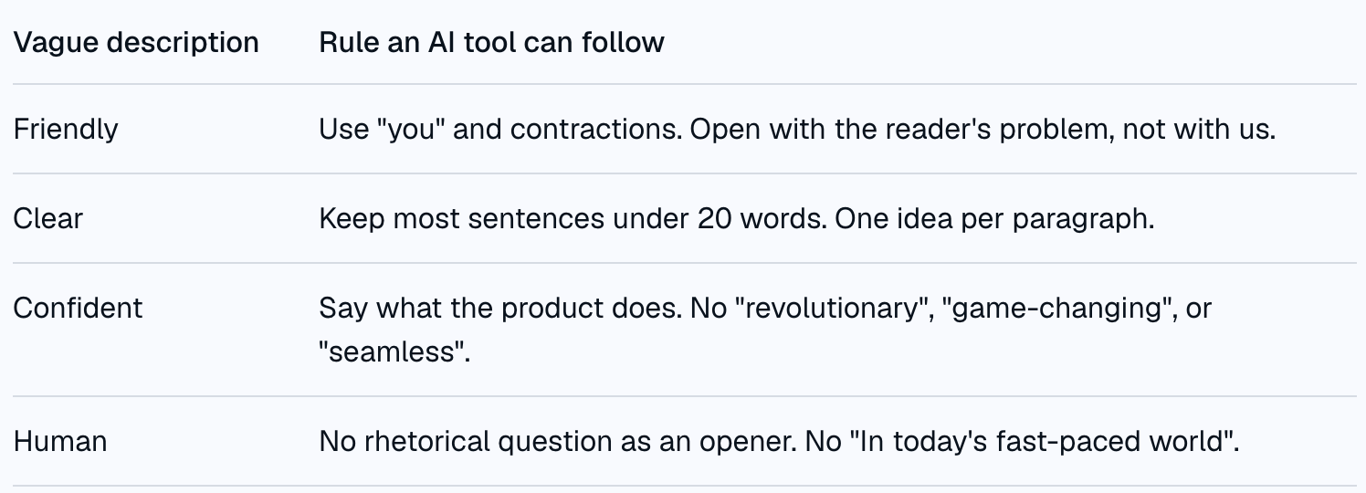
Add a short list of banned phrases. Every team has words that make it wince; put them in writing.
Step 3: Build a reusable voice prompt
Combine the rules into one block of text that you paste at the start of every request, or save it as a custom instruction or project setting in the tool you use. Include:
- Who you write for, in one sentence.
- Your rules from Step 2.
- Two short samples of your real writing, labelled "write like this".
- One sample that is off‑brand, labelled "do not write like this".
The negative example matters. Models learn as much from what to avoid as from what to copy.
Keep the prompt in a shared document so everyone uses the same version. When you change a rule, change it there.
Step 4: Edit for the patterns AI still gets wrong
Even with a good prompt, AI drafts drift. Watch for these on every piece:
- Uniform rhythm. Sentence after sentence of the same length reads as machine‑made. Mix short and long.
- Stacked hedges. "Can often help to potentially improve" should be "improves".
- Generic examples. Replace "a business" with a real customer type or a real situation.
- Tidy lists of three. Not everything comes in threes. Cut the weakest item.
Tools can speed up this pass. An AI humanizer such as Natural Write rewrites AI‑generated text so it reads more naturally, which leaves the human editor free to focus on facts, examples, and judgment. Use it as a first pass, not the last word: a person who knows the brand should still read every piece before it goes out.
Step 5: Review a sample every month
Voice drifts slowly. Once a month, pick three recent pieces and read them side by side with the originals from Step 1. Ask:
- Would a regular reader recognise these as ours without the logo?
- Did any banned phrase slip back in?
- Has the tool picked up a new habit we do not want?
Update the voice prompt with what you find. Small, regular fixes keep it accurate as your products and audience change.
Common mistakes to avoid
- Writing the guide only in adjectives. If a rule cannot be checked, nobody will follow it, including the model.
- Using a different prompt per person. One shared prompt keeps ten writers sounding like one company.
- Skipping the human read. AI tools and humanizers improve drafts. They do not know which claim is wrong or which example will annoy a customer.
Final thoughts
AI can draft in your voice, but only if you describe that voice in rules it can follow. Collect your best writing, turn its patterns into instructions, keep them in one shared prompt, and edit every draft against them. The result is content that is fast to produce and still sounds like you.