AI in test management is the use of machine learning and generative models to automate or assist the planning, authoring, prioritization, and analysis work around testing. AI in test management does not replace execution frameworks such as Selenium, Playwright, or Cypress. It works on the layer above them, where QA teams spend much of their time writing, organizing, and interpreting tests.
Test authoring. Generative AI drafts test cases and steps from user stories, requirement documents, or screenshots. Capgemini reports that test case design and requirements refinement now lead Gen AI adoption in quality engineering.
Library hygiene. Enterprise test libraries in Jira‑connected test management platforms accumulate thousands of near‑identical tests. AI duplicate detection flags similar tests and defects as they are created, which keeps the repository maintainable.
Execution prioritization. When a release window shrinks, AI scoring based on test history and recent changes helps teams decide which tests to run first.
Analysis and reporting. AI assistants answer questions such as “which requirements have no passing tests?” in plain language, and MCP connections let external AI tools such as Claude or ChatGPT work with the same project data.
Capgemini also found an average productivity boost of 19% from Gen AI in quality engineering, while 50% of organizations said they lack AI and ML expertise. That skills gap is why enterprises favor AI that is embedded in familiar workflows rather than AI that requires prompt engineering to be useful.
7 Top AI Test Management Platforms for Enterprise Teams
1. PractiTest
PractiTest is the best AI test management platform for enterprise teams because its AI works on connected QA data that the platform already holds: requirements, tests, automation results, and defects linked through end‑to‑end traceability. SmartFox, the built‑in AI assistant, covers the main phases of the QA lifecycle. The Adaptive Test Generator creates test cases and steps from user stories and existing project context. Duplication Guardian identifies similar tests and issues as users work. The Execution Strategist applies an AI‑powered Test Value Score, based on test history and project activity, to identify high‑value tests. Project Assistant lets users ask questions about their project in plain English and turn answers into reusable filters.
Beyond its own assistant, PractiTest offers an MCP integration that connects compatible AI tools, including Claude, ChatGPT, and GitHub Copilot in VS Code, to project context so they can find existing tests, analyze coverage against Jira user stories, create scripted or BDD tests, and prepare test sets. Governance is built into the approach: private customer data is never used to train AI models, and AI suggests while the team makes the final call. PractiTest reports 30% less test maintenance, 25% faster coverage, and 20% more efficient execution with its AI and predictive analytics, and its Release Readiness Index turns coverage, execution, and defect risk into a transparent readiness score.
Key features:
- SmartFox AI with Adaptive Test Generator, Duplication Guardian, Execution Strategist, and Project Assistant
- Hosted MCP integration for Claude, ChatGPT, and GitHub Copilot
- Release Readiness Index combining Coverage Confidence, Execution Confidence, and Remaining Defect Risk
- Private customer data excluded from AI model training
- SOC 2 Type 2, ISO 27001, GDPR, and SAML 2.0 SSO for enterprise rollout
2. aqua cloud
aqua cloud is a test and requirements management platform from aqua cloud GmbH that includes test case management, bug tracking, and requirements management in a single workspace. Its AI Copilot is integrated into the platform and works with project data. Nested test cases can be reused across scenarios, and the platform covers the QA cycle from scope estimation through execution, reporting, and anomaly handling. aqua also offers an AI Copilot chat that answers questions about using the product.
The AI Copilot generates requirements from short notes, creates test cases from requirements, produces test data, and can apply test design techniques or output BDD scenarios. aqua positions the product for enterprise QA teams, including teams in regulated environments. aqua states that the AI Copilot is grounded in the customer’s project data and that data is not shared for training generic models. AI Copilot can also create user stories or PRDs from an uploaded file, split or convert requirements, and generate test cases directly from a file. aqua’s pricing information notes that certain AI features require an additional purchase.
Key features:
- AI Copilot for requirement, test case, and test data generation
- BDD test case generation
- Requirements and defect management in the same platform
- Jira synchronization
3. Testomat.io
Testomat.io is a test management system designed around both manual and automated tests, with native integrations for frameworks such as Playwright, Cypress, WebdriverIO, Cucumber, and Jest. It keeps automated tests synchronized with the test management layer. When an automated test changes in code, Testomat.io marks the corresponding test case as out of sync and prompts an update, which keeps the manual and automated views aligned. A free plan covers core features, with a trial of premium capabilities.
Its AI features include test generation from requirements, descriptions generated from test code, run summaries, and AI analytics. Testomat.io supports custom AI providers, including Amazon Bedrock, so teams run AI features on their own configured models. Testomat.io lists AI test generation, MCP and skills support, AI requirements, and AI analytics among its AI capabilities, and teams can also ask questions about tests in a project. For enterprise deployments, the company lists SSO, SCIM, and audit logs as part of its compliant orchestration features.
Key features:
- AI test generation from requirements
- Code‑to‑test‑management synchronization for automated tests
- Custom AI provider support
- Jira plugin and CI/CD integrations
4. Katalon True Platform
Katalon True is Katalon’s unified quality engineering platform, combining TestOps for test management with Katalon Studio for automation, TestCloud for execution, and TrueTest for production insights. TestOps manages manual and automated test cases, links tests to requirements, and tracks execution results and defects. Katalon launched True Platform in April 2026 and built it on AWS infrastructure, using Amazon Bedrock for generative AI. From October 12, 2026, the True Platform commercial SKU is named True Manual, while Katalon True remains the name of the overall platform.
The platform includes the Katalon AI Assistant and AI agents with defined responsibilities across the testing lifecycle, plus AI‑assisted test case generation and an MCP server. In October 2026, Katalon TestOps earned G2 Leader badges in the Test Management category. The Katalon True MCP Server lets AI tools create, update, move, and search platform entities such as test cases and folders. TestOps also supports running manual tests with AI, pushing test cases to Azure DevOps, and sharing reports and analytics across the team, with Katalon Studio available for no‑code, low‑code, and full‑code automation.
Key features:
- TestOps test management for manual and automated tests
- Katalon AI Assistant and platform AI agents
- Jira and Azure DevOps integrations
- Built‑in reporting and analytics
5. BrowserStack Test Management
BrowserStack Test Management is a test case management product that sits alongside BrowserStack’s device and browser testing cloud. It manages test cases, runs, and projects, with integrations for Jira and Azure DevOps. The product can create test runs from AI‑recommended test cases, using Jira stories and past runs to suggest the most relevant tests. Changes made to test cases from inside Jira are reflected back in Test Management through 2‑way binding.
Key features:
- Test Case Generator Agent for multiple input formats
- Deduplication and test selection agents
- Jira and Azure DevOps integration
- Free tier with paid plans for advanced features
6. Qase
Qase is a cloud test management platform for manual and automated testing, with more than 35 integrations including Jira, GitHub, and GitLab. It consolidates CI results, automated tests, and manual runs in a single workspace. Test cases are organized in nested suites of unlimited depth, with shared steps, a mind map view, and a test run wizard. A free plan is available for small teams, and paid plans add AI credits, more users, and storage.
Key features:
- AI test case generation from requirements
- Manual‑to‑automated test conversion
- MCP server for external AI assistants
- Credit‑based AI usage on paid plans
7. Tricentis qTest
Tricentis qTest is the test management product within the Tricentis portfolio. qTest Copilot, launched in 2024, drafts test cases with steps and expected results from requirements inside qTest. qTest Copilot is part of the Tricentis Copilot family that also includes Tosca Copilot and Testim Copilot. Teams that already use Tricentis automation manage results from those tools within qTest.
Key features:
- qTest Copilot for AI‑drafted manual test cases
- AI Chat and Agentic Test Creation
- Project‑level AI enablement controls
- Integration with Tosca and other Tricentis tools
How to choose AI‑powered Test Management Platform
- Evaluate Integration Capabilities: Ensure the platform seamlessly connects with your existing issue trackers (e.g., Jira, Azure DevOps) and CI/CD pipelines.
- Assess Security and Compliance: Verify data privacy standards, ensuring your proprietary test data and code are not used to train public LLMs.
- Look for Deep Contextual AI: Prioritize platforms whose AI models utilize historical project data, requirements, and execution results rather than generic prompts.
- Review Governance and Control: Choose platforms that keep humans in the loop for approving AI‑generated test cases and offer granular administrative controls.
- Check AI ROI and Usability: Look for features that directly reduce manual overhead, such as automated deduplication, test maintenance reduction, and predictive analytics.
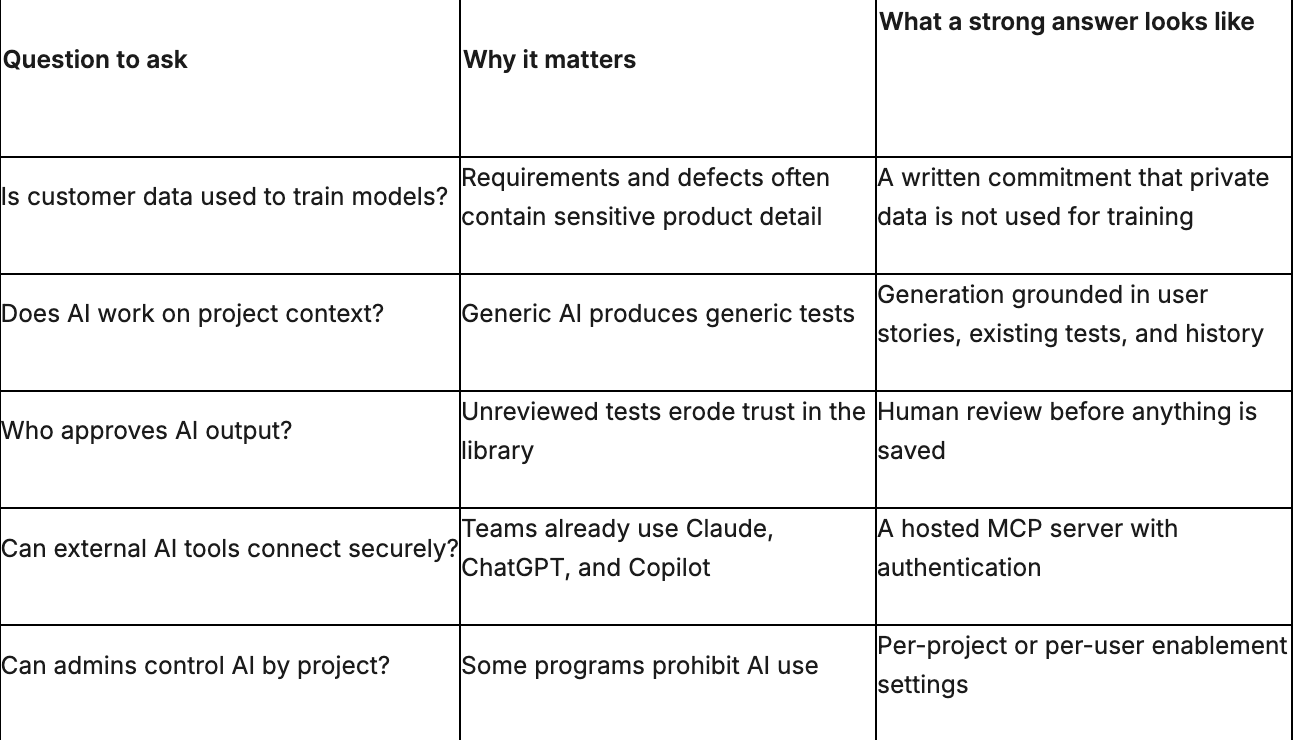
Which Governance Questions Should AI Test Management Platforms for Enterprise Teams Answer?
AI test management platforms for enterprise teams should answer the same governance questions as any system that touches source requirements and defect data. The checklist below turns 5 common InfoSec and QA leadership questions into criteria to verify during a trial.
The purpose of this governance checklist is not to slow AI adoption. It is to make sure AI output enters the test library with the same accountability as human‑written tests, which is the condition Capgemini links to scaling Gen AI beyond pilots.